
Affiliate disclosure: This guide may contain affiliate links. If you buy through them, StaysTidy may earn a commission at no extra cost to you. Read our Affiliate Disclosure.
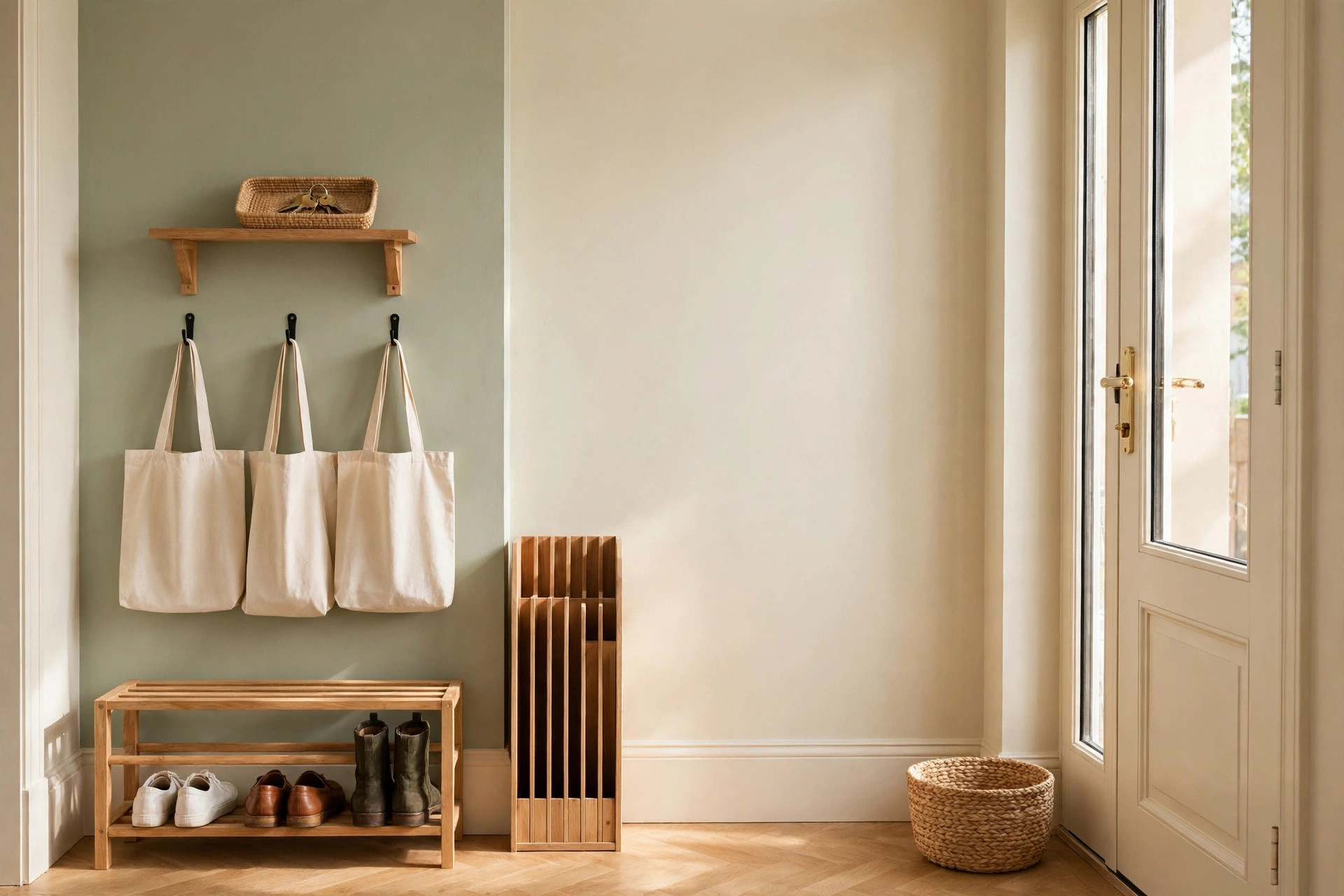
Every home has a spot where the day gets dumped: keys, post, shoes, bags, a coat over a chair. If that spot has no system, it grows. The drop zone is the fix — not a bigger hallway, but a deliberate landing strip where everything you carry in has exactly one home within your first three steps through the door. In about an hour, with no decorating and no renovation, you can set one up in any entryway — including a rental where “entryway” means one wall of the living room.
This system belongs with our Entryway, Living & Bath: First Steps, Calm Rooms guides, where every room system starts with the first three steps through the door.
PRO TIP: The rule that makes it work: the drop zone must be easier than the floor. If putting keys in their spot takes one extra decision, the keys will land on the nearest surface instead. Every element below is chosen to be the path of least resistance.
Measure first (5 honest minutes)
- Your landing width: stand at the door. The wall or floor space within one step left or right of the door swing is your zone. Measure it — most drop zones live in 24–48 inches (60–120 cm) of width.
- Door swing: mark where the door opens to. Nothing tall or wide goes in the swing path, ever.
- Shoe reality check: count the pairs that actually live at the door right now (not the pairs you wish lived there). That number sizes your shoe storage; the rest of the shoes move to the bedroom closet today.
- Household count: one landing spot per person, minimum. Shared mystery piles form when two people share one hook.
The 5 elements (in setup order)
1. Keys and post: one tray, one slot
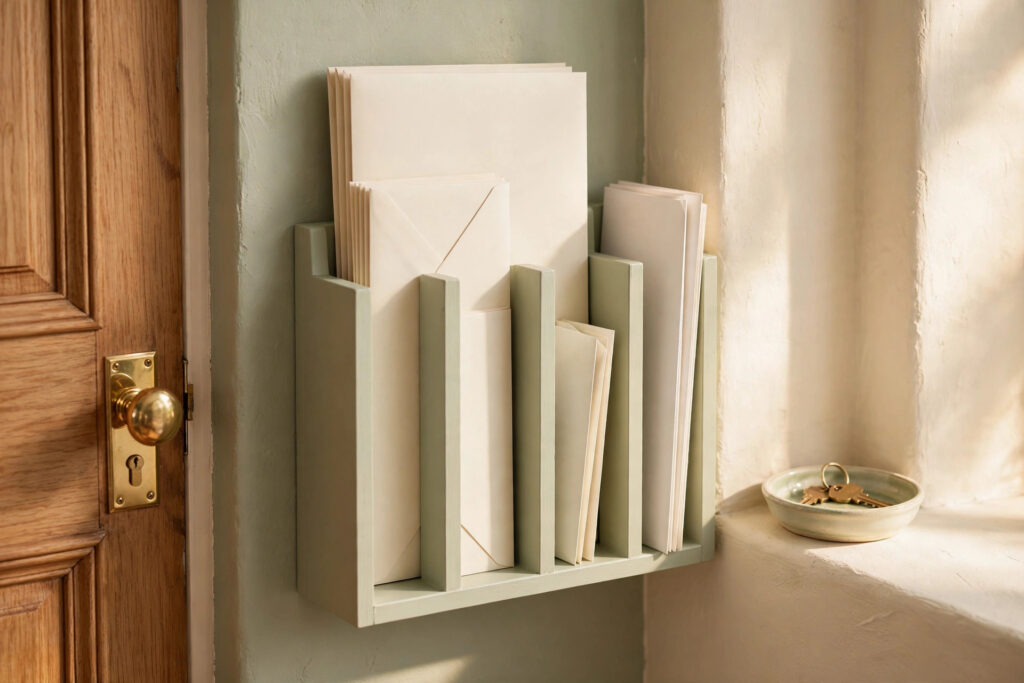
A single tray or shallow dish for keys — one per household if keys multiply. Beside it, one vertical slot for incoming post: a wall file, a standing magazine holder, anything with a hard capacity. When the slot is full, it must be sorted; the container is the reminder. No second pile is allowed to be born next to it.
2. Shoes: contained, off the floor
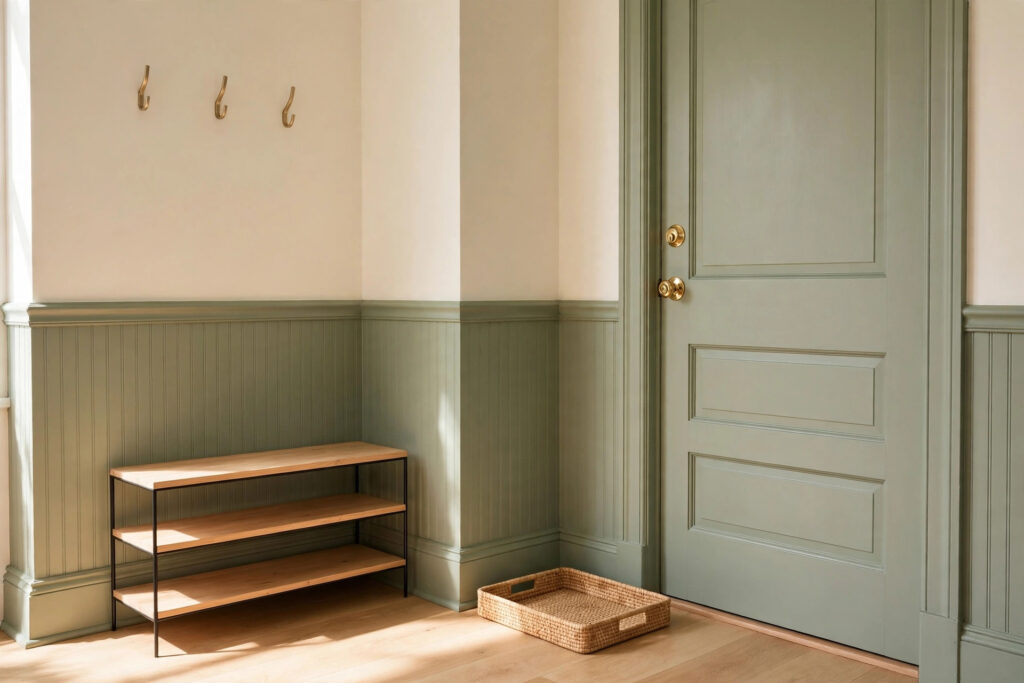
A low rack, a boot tray, or one basket per person. Renters: nothing here needs screws — freestanding racks and trays only. Set a house rule the container enforces: if it doesn’t fit, it doesn’t live here. Overflow shoes go to the closet the same day, not “later this week.”
3. Bags: one hook per person at the right height
Hooks should be at the height of the person who uses them — a bag hook at adult shoulder height for a seven-year-old is decoration. Over-door hooks on a nearby hinged door, a freestanding coat stand, or removable hooks on a hall wall (with the same paint caution as all adhesive: test, light loads, removable strips). Each person gets one hook and one bag at a time in the zone.
4. The out-box: things that must leave

A small basket for returns, library books, things to give back to people. Most entryway clutter is not incoming — it’s outgoing things waiting by no door in particular. One labeled out-box stops them colonizing the shoe rack.
5. A 30-second reset habit
The system stays tidy because of the nightly 30-second version of our 10-minute nightly reset: keys in the tray, shoes in the rack, one thing into the out-box. That’s it. The drop zone is small enough that half a minute genuinely covers it.
Setting it up in an hour
- Empty the zone completely (10 min). Everything off the floor and the surface. Clean it — you are about to see this square metre more kindly.
- Sort by owner and by verb (10 min): stays here / lives elsewhere / leaves the house. Be ruthless with “leaves the house eventually” — it goes in the out-box or it goes today.
- Place the big containers first (15 min): shoe storage, then bag hooks or stand, then the tray and post slot at natural hand height as you enter.
- Live-test it (10 min): walk out, walk back in carrying your usual load. Where did your hands want to put things? Move the tray to exactly there. The zone must fit your body’s autopilot, not a photo.
- Set the capacities in words (5 min): tell the household the rules — one hook each, shoes that fit, post slot sorted when full. Systems people can state in one sentence are systems that survive.
Seasonal swaps without chaos
A drop zone fails in November when summer’s sandals still own the shoe rack. Twice a year, do a 15-minute swap: out-of-season shoes and coats leave the zone for a labeled box in the closet or under a bed, and the incoming season takes exactly the same slots. The capacity never changes — only what fills it. If the box comes back next season with items nobody reached for, those items are telling you something; the zone is too small to store maybes.
What to skip
- A drop zone with no container limits. Open surfaces without boundaries become the pile they were meant to replace.
- Pretty baskets for shoes in a wet climate before a boot tray: the tray catches the water; the basket becomes soup. Tray first, looks second.
- Replicating a mudroom you don’t have. This system is one wall and five elements. If it needs furniture shopping to start, it’s the wrong plan for this weekend.
Keep it tidy
The reset habit (element 5) is the whole maintenance plan, plus one weekly pass at the post slot before it overflows. If a new category of clutter appears (sports kit, dog gear), it gets a named container or it doesn’t live here — unnamed things pile.
FAQ
My entryway is just a wall behind the door. Can this still work?
Yes — that is the most common case. Tray on a small wall-mounted or over-door spot, shoe tray on the floor, one hook per person. The system scales down to a single metre of wall; it only fails when it has no boundaries at all.
Renters: can I do this without holes?
Everything here is freestanding, over-door or tray-based. If you use removable hooks, keep loads light and follow the packet’s removal method — and never on wallpaper.
How do I stop kids dumping bags on the floor?
Lower the hook to their height, make their basket big enough for the actual bag, and make the floor rule visual: shoes and bag inside the containers or carried to their room. Convenience wins every time — if the floor is closer than the hook, move the hook.
What about guests’ coats and shoes?
Give the flex spot a job: one empty hook and the end of the shoe tray are “guest space,” kept empty on purpose. When guests aren’t there, that emptiness is what stops your own overflow from spreading.
Get the printable
Entryway Drop Zone Setup Sheet
One page: the measurement prompts above, the 5-element checklist, and a house-rules line to fill in.



7 thoughts on “Entryway Drop Zone: A System for Keys, Shoes and Bags in 1 Hour”