
[AFFILIATE DISCLOSURE] This guide may contain affiliate links. If you buy through them, StaysTidy may earn a commission at no extra cost to you. Read our Affiliate Disclosure.
School mornings generate a very specific chaos: one missing permission slip, one bag that was never unpacked, one schedule nobody checked. A school command centre fixes this by giving the whole school operation one wall — usually the same entry wall as your drop zone — where bags land, papers get judged, and tomorrow’s schedule is visible at child eye height. It is not a craft project. It is traffic engineering for small people with important documents.
Everything here is renter-friendly (over-door, freestanding or removable-strip options) and cheap to change in September, because the system has to survive the school year’s growth spurts — the kid’s and the paperwork’s.
For the full category view, start with Kids, Paper & Home Office: Systems for Busy Households.
Where it lives, and how much wall you need
Measure before shopping, as always:
- Wall width: one bag-width per child, plus a paper station. Plan roughly 16–24 inches (40–60 cm) per child if bags hang side by side; tight entries can stack hooks at two heights instead.
- Heights: hooks at each child’s shoulder height now, with room to move them up. A hook a child can’t reach is a floor pile with extra steps.
- The paper point: one slot/folder per child for incoming school paper, at adult hand height — children deliver, adults judge. This boundary is the whole system.
- Calendar position: at adult eye height near the paper point. If the schedule isn’t visible at the moment papers arrive, papers will be “dealt with later,” which is to say, piled.
The 5 stations
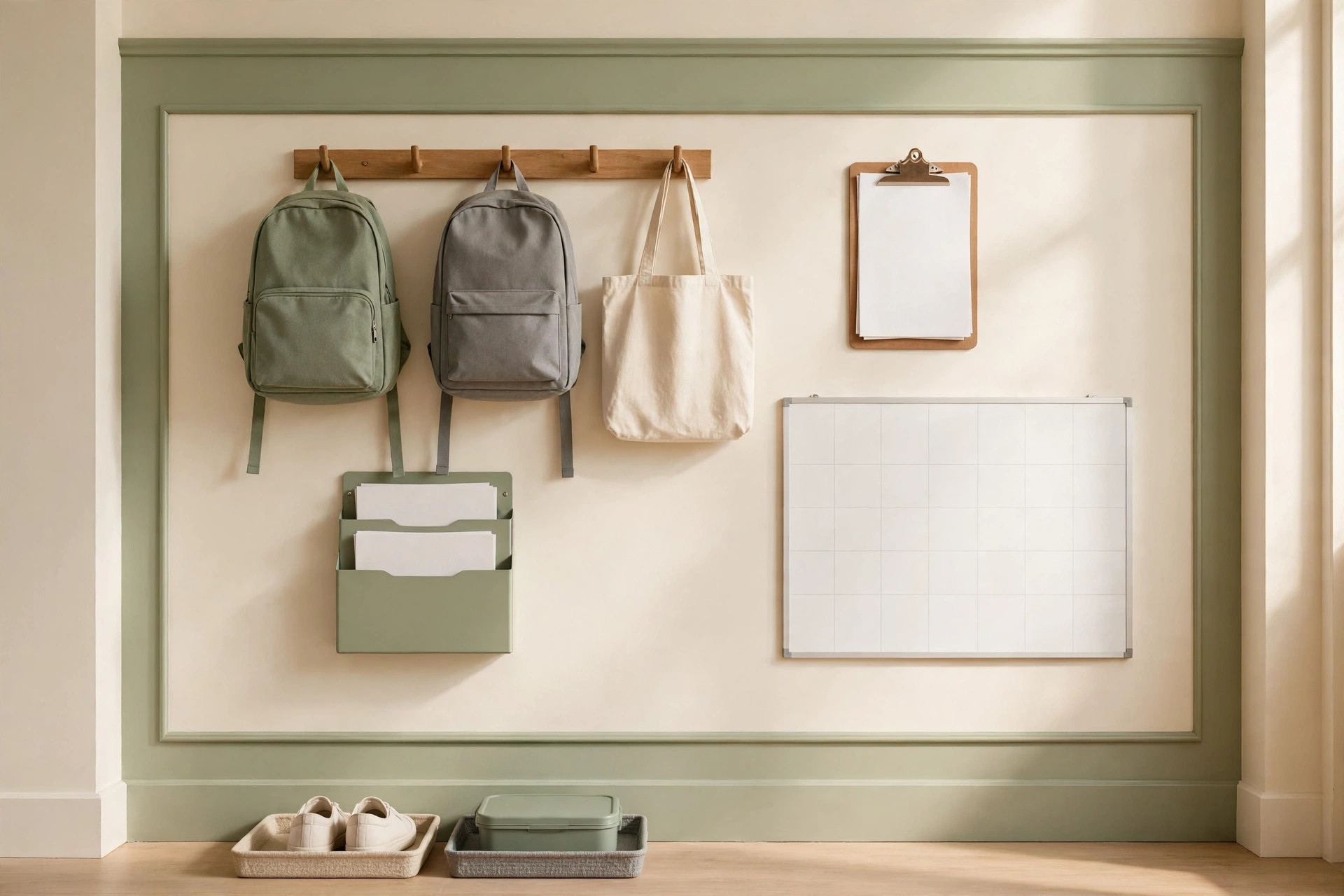
1. Bag hooks (one per child, named)
One hook, one bag, one name. Names matter at 7 a.m. When bags are identical school-issue, a ribbon, tag or tape flag with the child’s name ends the daily mix-up. Weekend rule: bags stay on hooks, not bedrooms — Monday morning starts at the wall, not with a search.

2. The in-tray per child (deliver here)
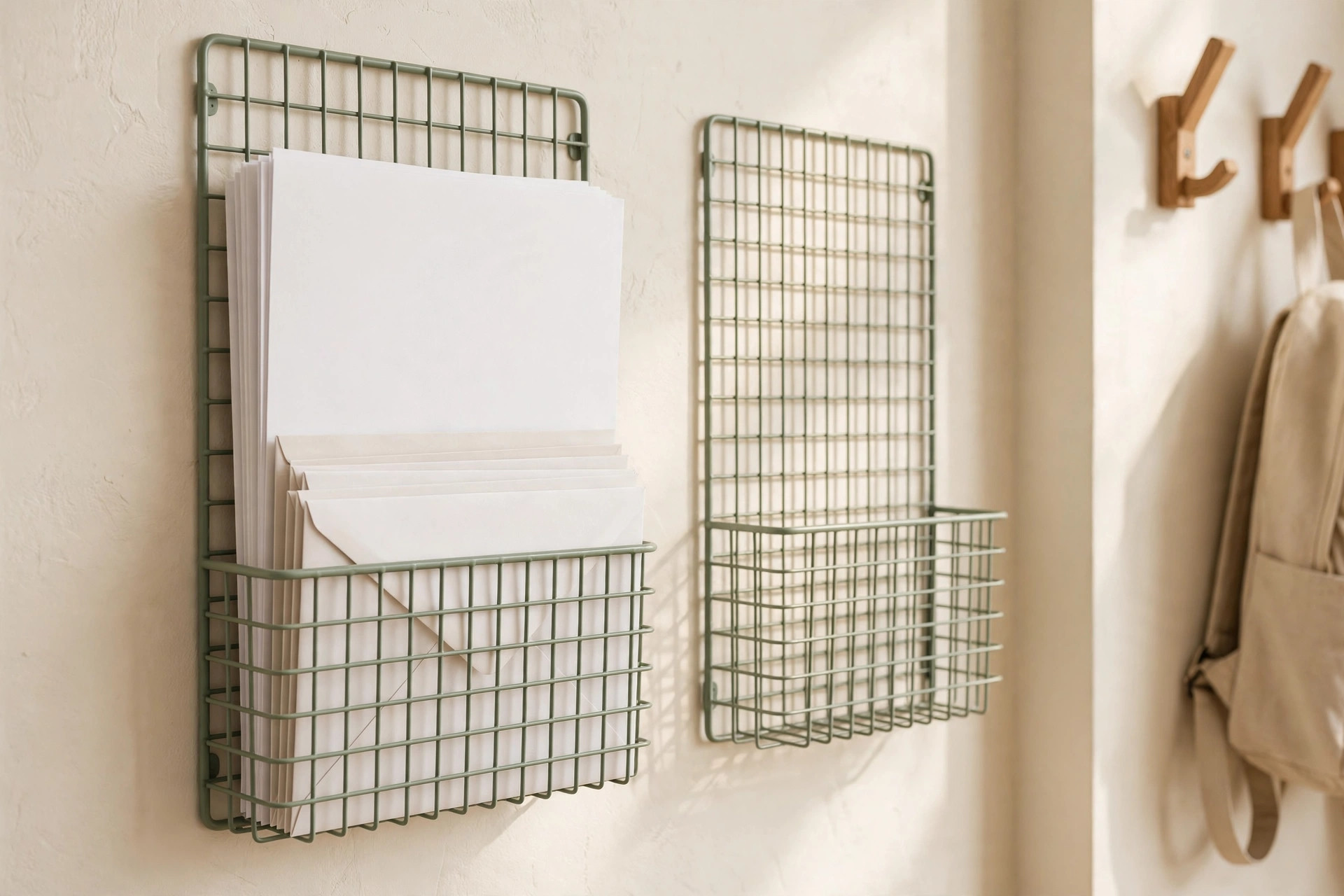
A wall file, a standing holder, or a shallow tray per child at the paper point. Everything from the bag that is paper goes in the tray that evening — not in the morning rush. The evening empty-bag pass is 60 seconds and is where permission slips stop dying at the bottom of bags.
3. The action clip (this week’s non-negotiables)
One clipboard or clip on the wall for what needs action before Friday: the slip to sign, the form to return, the costume note. Maximum three items — when a fourth arrives, something must be signed, paid or consciously dropped. The clip is a hard capacity, like the paper system’s action tray: overflow means act, not expand.

4. The week-at-a-glance board
A whiteboard, cork board or a printed weekly sheet in a frame — whichever your household will actually update. Each child gets a row or a colour; PE days, library days, and kit-needed days are marked once, on Sunday, from the school schedule. Keep it factual and boring. Its job is to answer “what do I need tomorrow?” without a parent being asked.
5. The launch pad (floor zone under the hooks)
The shoes, the lunchbox, the library book due tomorrow — staged under each child’s hook the evening before. A small tray or basket per child on the floor keeps launch pads separate. Morning-you then does zero thinking: everything under your hook goes with you.
The evening loop (the habit that runs it)
Sixty seconds per child, same time nightly — ideally folded into the 10-minute nightly reset:
- Bag emptied: paper to the in-tray, lunchbox to the kitchen, everything else back in the bag or binned.
- Tomorrow checked on the board: kit, book, slip staged on the launch pad.
- Bag re-hung. Done.
Parents’ parallel pass (5 minutes, twice a week): clear the in-trays using the 4 verdicts from the paper system (act / file / refer / recycle), clear the action clip, and update the board. School paper that matters this term lives in the home paper system; artwork gets its own route in kids’ artwork without the guilt pile.
Setting it up (one hour, mostly measuring)
- Mark hook heights on the wall with painter’s tape — children standing, shoulder height, then test with the real bag.
- Install hooks (removable options for renters; check load ratings on the packet and keep to one school bag per hook — hooks that sag get ignored, then the floor wins).
- Place in-trays at adult hand height beside the hooks; label with names.
- Board at adult eye height; write this week before the system goes live. An empty board teaches nobody anything.
- Launch-pad trays on the floor under each hook.
- Run one practice evening loop with the kids so the routine is a demo, not a lecture.
What to skip
- Elaborate decor-first command centres. If it’s prettier than it is usable at 7 a.m., it’s wall art. Boring and reachable wins.
- One shared paper pile for all children. Shared piles are where slips go to be someone else’s problem. One tray per child, named.
- Storing the whole term’s paper on the wall. The wall holds this week; the archive box holds the term (paper system, above).
- Hooks at adult height “for neatness.” Children use what they can reach. A floor pile is the review of a too-high hook.
Keep it tidy
Weekly: board rewritten on Sunday, in-trays cleared, launch pads reset. Termly: hook heights re-checked against growing shoulders, dead papers archived or recycled, last term’s launch-pad contents evicted. Systems for children need scheduled resizing — put it in the calendar now.
FAQ
No spare wall near the door — where else can it live?
The wall nearest the breakfast spot works nearly as well; bags travel a few extra steps but papers, board and launch pad stay together. Keeping the five stations together matters more than the exact wall.
Renters: will removable hooks hold a school bag?
A loaded school bag is heavy — check the specific product’s rating and surface rules, use the largest recommended strips, and consider a freestanding coat stand or over-door rail on a nearby hinged door instead. Never hang a heavy bag on an untested hook over a walkway.
Two kids share one small entry. Can stations stack?
Yes: hooks at two heights on the same wall segment, in-trays stacked vertically at adult height, launch pads side by side. Name everything; sharing works when ownership is labelled.
How do I keep the board updated instead of becoming wallpaper?
Update it during the twice-weekly parent pass, from the in-trays — new info enters via paper, not by remembering. If the board is wrong twice, kids stop reading it; accuracy is the habit that keeps it alive.
