
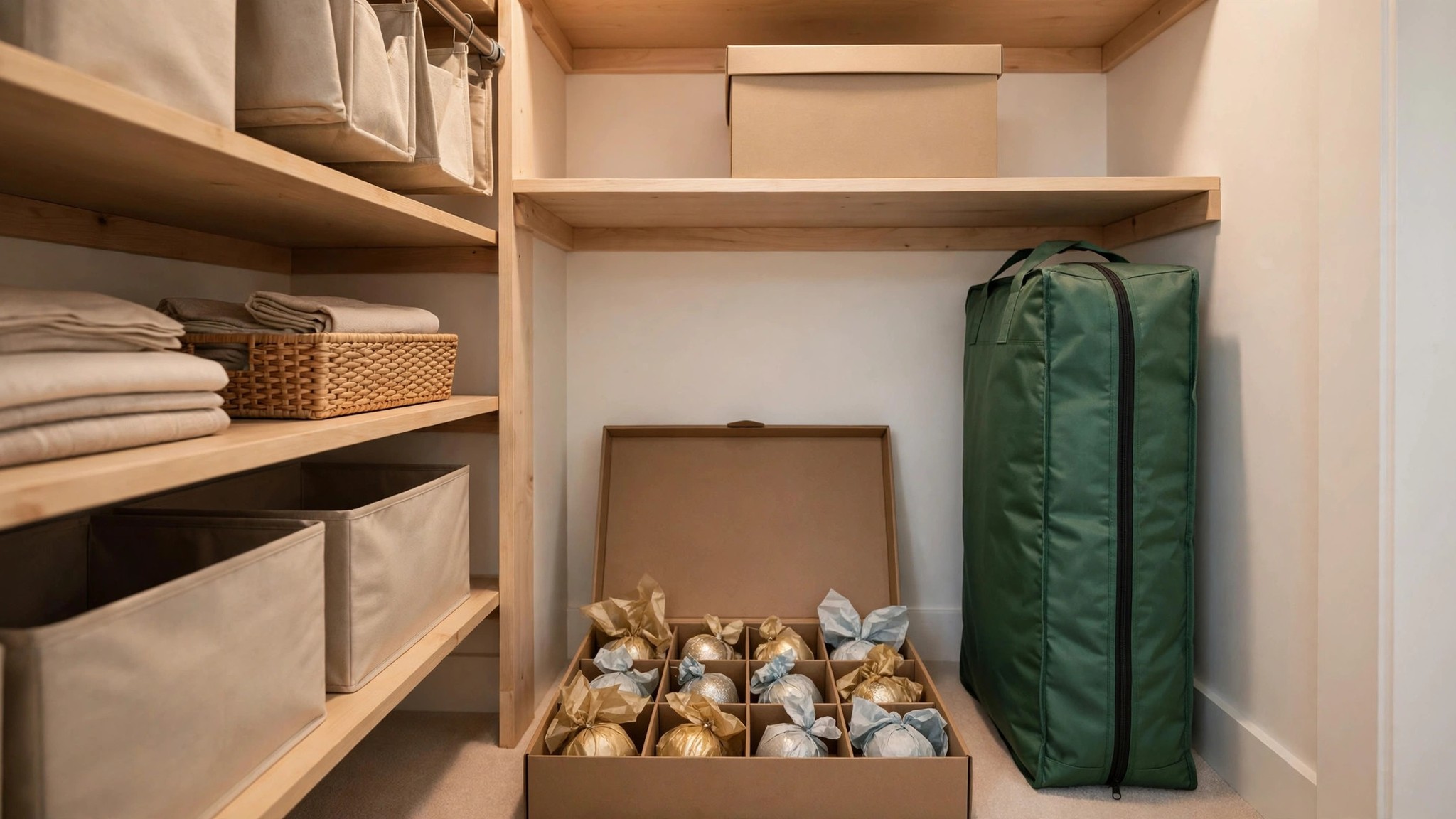
The decorations come down the way they always do: in a rush, on a tired January afternoon, into whatever box is nearest. The lights go in as a knot with tinsel in it. The ornaments go in loose, wrapped in hope and one layer of last year’s tissue. The tree gets wrestled back into a cardboard box that was already disintegrating last year.
Then next December, you open the box to a cracked bauble, a dead strand of lights, and eleven months of dust.
Packing away is not the boring tail end of Christmas. It is the first day of next Christmas — the version of the holiday your future self inherits is decided by how this one is stored. The good news: christmas decoration storage in a small or rented home does not need an attic, a garage or a storage unit. It needs a takedown order, containers that match the pieces, and one shelf’s worth of honesty.
First, the honest inventory
Before anything goes into a box, gather every decoration you own into one room — tree pieces, ornaments, lights, garlands, stockings, the tabletop things. Most people are surprised twice: by how much there is, and by how much of it quietly failed this year.
Sort the pile with a cold eye:
- Keep: the pieces you would buy again today — the ornaments with a story, the lights that worked, the garland that still looks like a garland.
- Demote: the still-working but tired pieces — the spare strand, the baubles that lost their sparkle. These become the spares box — stored separately, labelled as spares, not mixed in with the pieces you love.
- Let go: the strand that failed for the second December running, the ornament already cracked, the novelty item nobody hung this year or last. This is the one in, one out system running in reverse: every piece you store costs a year of shelf, so only pieces that earned it get one.
Note what broke and what you ran short of — a card in the first box you will open next year. Then measure two things while the tree is still standing: its assembled height, and the length of its longest section once apart. Both numbers decide your tree storage below — and both are unguessable in a shop in November.
When to take it all down
Tradition has an answer: Twelfth Night and Epiphany, around 6 January, when many homes have always taken the tree down. Plenty aim for New Year’s Day instead; plenty drift into mid-January. All are right, because the honest answer to when to put away christmas decorations is practical, not mystical: in early January, in one unhurried session, while you still remember which strand flickered.
What matters is the single session. Not 26 December, exhausted, shoving things into bags — and not a bit here and a bit there across three weekends, which is how ornaments end up in the kitchen drawer. One session, because the system below is one flow: inventory, takedown, containers, labels, done.
Treat it as part of the January reset. Packing away the decorations is one half of that reset; the other half is the wrapping supplies, and our gift wrap storage system gives the paper, bags and ribbon the same audit-first treatment. The kitchen got the same habit in November with the leftovers and restock system — count honestly first, store second.
The takedown order: room by room
Order is the whole trick. Worked in the wrong order, takedown is an afternoon of carrying fragile things back and forth past open boxes. Worked in this order, every piece is handled once and lands in its final home.
- Set up before you touch a decoration. One clear surface for packing, and every container out and open first — ornament trays, lights box, tree bag unzipped and waiting. Containers still in the cupboard is how pieces end up “temporarily” on the sofa.
- Small decor first, one room at a time. Stockings, garlands, wreaths, tabletop pieces, window things. Finish a room completely — everything off, everything packed — before moving on. Small decor is quick and hard to break, and clearing it first gives you clean surfaces for the fragile work.
- Ornaments next, straight into their trays. Take each ornament off the tree and place it directly into its compartment or its tissue. An ornament handled twice is an ornament at risk; an ornament set down “for a minute” is how the breakage happens.
- Lights off the tree, and wound immediately. Not coiled loosely “to deal with later” — wound, the moment each strand comes off, using the method below. Later is where the knot is born.
- The tree last. Sections apart, straight into the bag, zipped, done. The tree is the bulkiest and least fragile thing you own; it can wait while everything delicate gets your fresh attention.
- Photograph, then label, then close. Before any lid goes on, photograph the open box — next December, that photo is your contents list. Then take one photo of the decorated room, for next year’s layout. Label every box with room and contents: “Living room — ornaments, fragile” beats “Xmas stuff” eleven months from now.
Ornaments: divided, wrapped, handled once
Christmas ornament storage succeeds or fails on one principle: no two fragile pieces ever touch. Everything in this section is just that principle, applied.
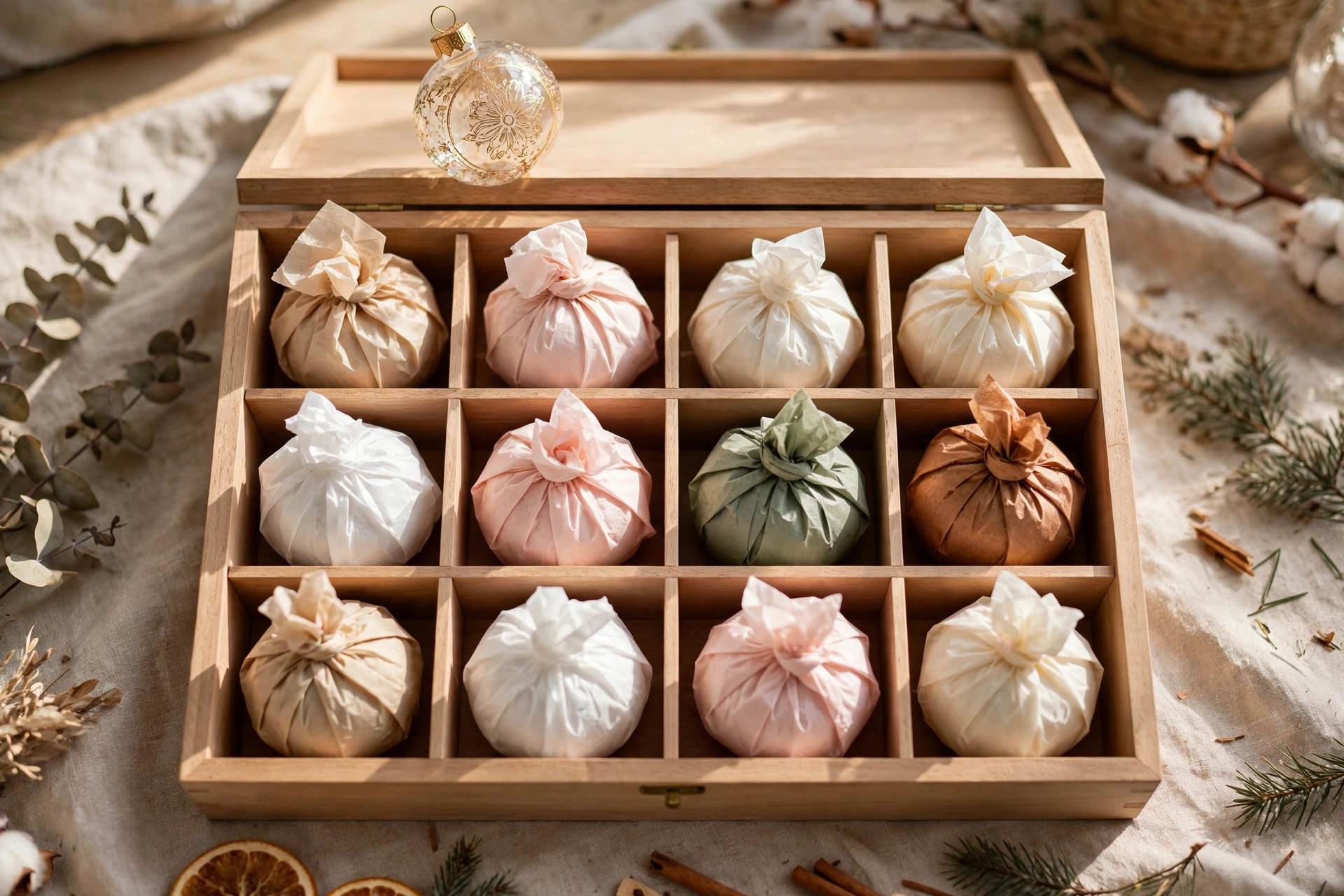
Divided trays are the system. Ornament storage boxes with divided trays — a grid of compartments, one bauble per cell — stop the piece-on-piece contact that chips paint and cracks glass. Stackable trays let a whole tree’s worth live in one box, layered by weight: heaviest, sturdiest ornaments in the bottom tray, lightest and most delicate on top, so nothing fragile ever carries weight.
Wrap the delicate ones anyway. A tray stops contact; tissue stops the small knocks between tree and box. A single sheet of tissue around each fragile or genuinely loved piece is the cheapest insurance here. The truly sentimental few — the handmade, the inherited — earn their own small box, stored on top, never underneath anything.
No budget for trays? The principle still works. Egg cartons cradle small baubles. A cupcake tray or a cut-down cardboard grid in a shoebox separates a layer. Wine-box dividers are practically ornament trays already. The product is optional; the separation is not.
Store the box like it’s fragile — because it is. Top shelf, or on top of the stack — never at the bottom of a pile. Ornaments survive December beautifully and die in February, crushed slowly by whatever got stacked on them.
How many ornaments for a 6 foot tree?
A 6 foot tree takes roughly 60 to 90 ornaments for a full look — about ten per foot of height, plus a few spares for the inevitable casualty. A sparse, modern tree can look finished with 40 to 50; a heavily layered traditional tree can take over 100. The number matters for storage, not just for decorating: count your ornaments during the inventory step, then buy trays to match the count you actually own. A tray box rated for 60 ornaments does not help a tree that hangs 85 — the overflow pieces are the ones that end up loose in a bag, and loose is how ornaments break.
Custom ornament boxes: worth it for the heirlooms
Most ornaments are fine in a standard divided tray. The exceptions are the pieces you could never replace — handmade, inherited, or genuinely expensive. For those few, a custom ornament box with dividers sized to the piece is worth it: the ornament cannot shift, cannot touch a neighbour, and the box itself signals “open carefully” in a way a generic tray does not. Buy custom for five pieces, not fifty; the rest of the tree belongs in ordinary trays.
The tree: a bag, measured first
The original cardboard box is the worst tree storage most homes use: it softens every year, and by year three it protects the tree from nothing — not dust, not crushing, not the pile. This is why christmas tree storage bags exist: a zipped bag keeps dust and damp off for eleven months, holds the sections together and has handles, which the box never did.
Measure before you buy — the same rule as every container on this site. You need two numbers from the inventory step: the tree’s height (bags are sold by the tree size they fit) and the length of the longest section, the dimension that defeats people. A bag the sections fit into, zipped fully closed, is the whole job. A bag too small gets left half-open, and a half-open bag is just a dust collector with ambition.
Lay the sections in the bag in rebuild order: the section you’ll need first next year goes in last, on top. Tuck the inventory card — what broke, what to replace — into the bag’s pocket or on top of the sections. Then store the bag upright in a closet corner if you have the height, where nothing rests on it; smaller trees can lie flat under a bed. Keep it out of damp spaces: a bag keeps dust off, but it is not a boat.
Lights: wind them now, or untangle them in December
There is no version of next December where you are glad you shoved the lights in loose. The tangle is not bad luck; it is a decision you are making right now, in January, at about ninety seconds per strand.

The wind-up method: take a stiff piece of cardboard — a cut-down box side is perfect — and wind each strand around it, end to end, snug but not stretched. Plug the strand’s two ends into each other so it cannot unwind, and write on the card where the strand lived: tree, mantel, porch. That label matters: strands are lengths, and next year you will want the long one for the tree without testing all four.
Test before you store. Plug each strand in while it’s still on the tree or as it comes off. A strand that failed goes now, and its replacement goes on the inventory card. Discovering a dead strand is a January errand; discovering it mid-decorating is a December crisis.
Store the wound cards flat in one shallow box — the lights box — on the same shelf as the ornaments. Flat, dry, labelled, boring: that is what tangle-free actually looks like.
One home for the whole season
Now the small-home reality check — none of this matters if the boxes have nowhere to live. The entire season — tree, ornaments, lights, small decor, and the wrap station from our gift wrap article — fits one honest footprint in most small homes:
- The closet corner: the tree bag, standing upright.
- The closet top shelf: the ornament box on top of the stack, the lights box beside it, small decor in one labelled box.
- Under the bed: the flat wrap tote, and a smaller tree if the corner is taken.
One footprint, nothing drilled, nothing fixed — every piece reachable without moving three other boxes first. And if your inventory genuinely does not fit the footprint, that is information, not failure: the footprint is the honest size of your storage, so the inventory shrinks to meet it at the next honest count. A small home does not need fewer celebrations — it needs a Christmas that fits in one closet.
FAQ
When should I put away my Christmas decorations?
Early January, in one unhurried session, is the practical answer; tradition points to Twelfth Night and Epiphany, around 6 January, and many households aim for New Year’s Day. Putting away christmas decorations while you still remember which strand flickered is what makes the inventory notes — and next December — work. Avoid the exhausted 26 December shove, and don’t let it drift for weeks.
Can I store my Christmas tree without its original box?
Yes — a tree bag is usually better. Christmas tree bag storage keeps dust and damp off the sections for the full eleven months, zips fully closed, and has handles for the closet corner or under-bed. Measure your longest section before buying, lay the sections in rebuild order, and keep the bag dry and uncrushed. The original box softens every year and protects the tree from less and less.
How do I store fragile ornaments so they don’t break?
One piece per compartment, and nothing heavy on top. Divided trays inside ornament storage boxes are the reliable version; tissue around each delicate piece handles the small knocks, heaviest ornaments go in the bottom layer, lightest on top, and the truly sentimental few get their own small box on top of everything. Egg cartons and cupcake trays are honest budget substitutes for small baubles.
How do I stop Christmas lights tangling in storage?
Wind them as they come off the tree — that timing is the secret. Wrap each strand around a stiff piece of cardboard, plug its ends together so it can’t unwind, label the card with where it lived, and store the cards flat in one box. Test each strand before storing it, so a dead one is replaced in January instead of discovered in December.
I’m a renter with no attic — where does all of this go?
Into one footprint: the tree bag upright in a closet corner, the ornament and lights boxes on the closet’s top shelf (ornaments on top of the stack, never under it), flat things like the wrap tote under the bed. Nothing here needs drilling, fixing or a storage unit. If it doesn’t fit, the inventory is bigger than the home’s honest storage — shrink the inventory at the next honest count.
Next December starts in January
None of this asks for a bigger home, a storage unit or a colour-coded label maker. It asks for one honest inventory, a takedown in the right order, separation for the fragile things, a measured bag for the tree, ninety seconds of winding per light strand, and labels written for a person you will be in eleven months. Do it once and two things happen: January gets its home back in a single afternoon, and next December opens with a photograph, an inventory card and boxes that contain exactly what their labels promise. Small home, full Christmas, no knot of lights. That’s the whole promise.
Planning the pack-away on paper? The free checklists in the StaysTidy Printable Library — including the 10-Minute Nightly Reset — are built for exactly these small, finishable January jobs.



2 thoughts on “Christmas Ornament Storage for Small Homes: The Takedown System for Trees, Lights and Everything Fragile”