

Affiliate disclosure: This guide may contain affiliate links. If you buy through them, StaysTidy may earn a commission at no extra cost to you. Read our Affiliate Disclosure.
If you rent, your closet probably came with exactly one rail, one high shelf, and nowhere to put anything else. You cannot screw in extra rails, you cannot lose your deposit to anchor holes — and the usual advice (“just add shelving!”) assumes you own the walls. This guide is the no-drill version: eleven ways to add real storage using tension, weight, doors and freestanding pieces, plus the honest limits of each method so you do not waste money on things that slide, sag or take paint with them.
For the full category view, start with Closets & Wardrobes: Systems That Fit Real Closets.
PRO TIP: A note before we start: every idea here is a method, not a promise. Adhesive and tension products behave differently on every surface and every load. Always check the rating on the specific product you buy, start lighter than the rating, and test for a week before loading anything precious.
Measure first (10 minutes that save every return)
- Closet width, depth and height — inside measurements, in inches and cm.
- Door type: hinged swing door, bifold, sliding, or curtain/no door. This single fact decides which ideas work. Over-door products only fit hinged doors with enough clearance at the top; sliding and bifold doors rule them out completely.
- Rail height and the dead space below it — measure from the floor to the rail, and from the rail to the shelf above. Most wasted closet space is the gap between hanging clothes and the floor.
- The widest thing you store — boots, a vacuum, a suitcase. Give it a home first, then plan around it.
The 3 no-drill principles
1. Tension works where walls are parallel. Tension rods and tension shelves push against two facing surfaces. They are strong in narrow alcoves and between closet side walls, weak in wide spans. The narrower the span, the better they hold.
2. Weight beats sticky. A freestanding frame standing on the floor carries load through gravity and does not care about your paint. Whenever a freestanding option exists, it outlasts an adhesive one.
3. The door is storage you’re already paying for — if it is a hinged door with clearance. A door that opens flat against a wall can carry a rail’s worth of items on its back.
The 11 ideas
1. A second tension rail under the first
If your shirts hang with 20+ inches (50 cm) of empty air beneath them, add a tension rod at about waist height and double-hang shirts, folded trousers and kids’ clothes. Span matters: in closets wider than about 48 inches (120 cm), mid-span sag becomes the failure point — hang lighter items in the middle.
2. Hanging fabric shelves from the rail

A fabric hanging organizer turns one rail segment into 5–6 cubbies for folded jumpers, jeans and bags. Honest limit: cubbies sag under heavy denim stacks. Keep stacks to 4–5 items and put the heaviest cubby at the top where the support is.
3. Over-door rail or rack (hinged doors only)
An over-door hook rail adds bag, scarf and tomorrow’s-outfit storage without a single hole. Check two things before buying: the door’s top clearance (the frame gap must fit the hook thickness) and whether the door still closes fully with it on.
4. Clear over-door shoe pockets — for everything except shoes
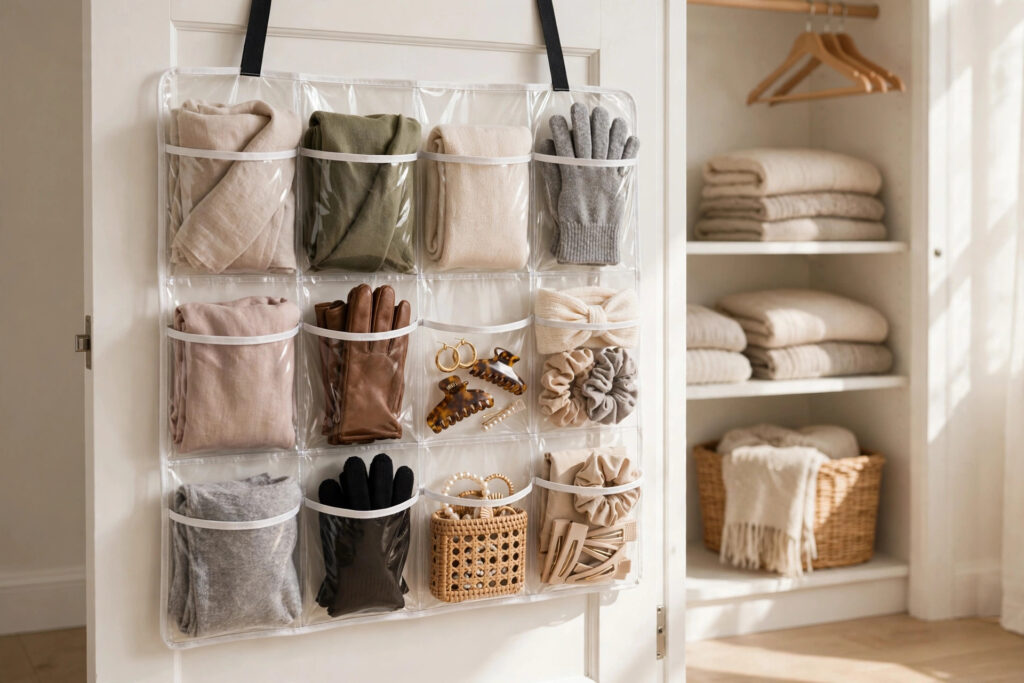
The 24-pocket door organizer is mediocre for shoes and brilliant for gloves, hats, chargers, sunscreen, pet leads and craft supplies. Small things you can see are small things you can find.
5. Stackable open crates on the closet floor
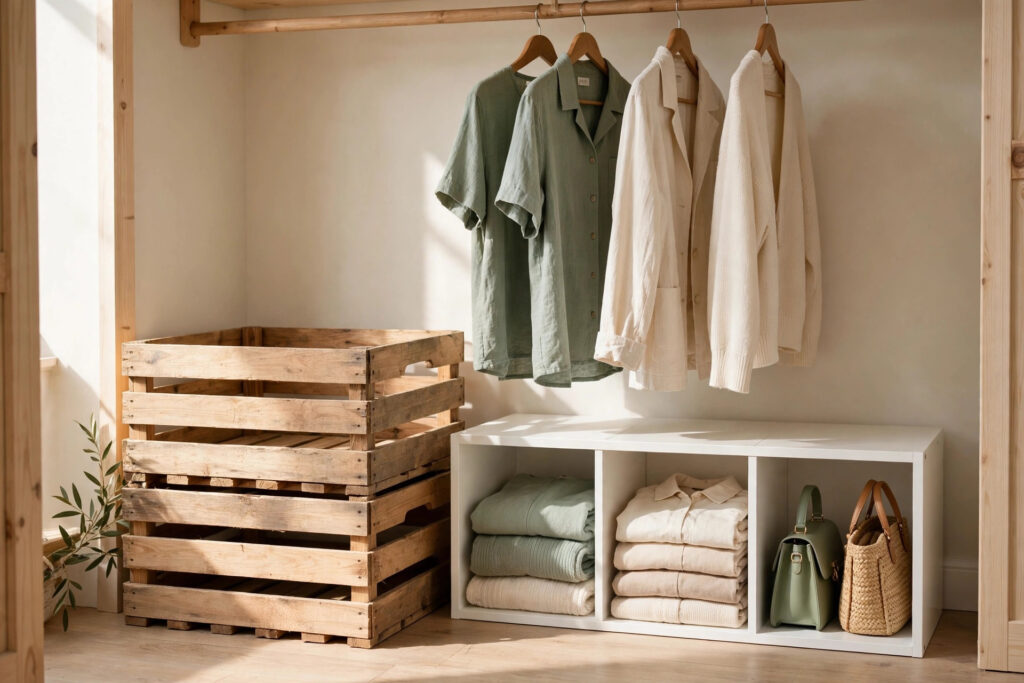
Two or three stackable crates turn the floor under short hanging clothes into shelving. Open-front crates beat lidded boxes — anything with a lid becomes a “later” pile within a month.
6. A slim rolling cart in the side gap
Many closets have a 6–10 inch (15–25 cm) dead strip beside the clothes. A narrow rolling cart slides in there and holds shoes, bags or cleaning supplies, and rolls out when you need it.
7. Under-shelf baskets on the existing top shelf
Baskets that clip onto the existing shelf edge double the top shelf for light items — scarves, caps, out-of-season smalls. Keep them light: the clip grip is the limit, not the basket size.
8. Adhesive hooks — used honestly
Adhesive hooks work on smooth, clean, non-textured surfaces and fail on matte paint, wallpaper and anything dusty. Use them for genuinely light things (caps, lanyards, a single bag), follow the curing time on the packet before hanging anything, and expect removal to occasionally take paint anyway. If your deposit matters more than the hook, skip this idea entirely and use the door.
9. Tension-rod shelf dividers
A short tension rod mounted front-to-back on a shelf creates a divider that stops folded stacks toppling sideways. Two rods make three tidy bays. Simple, removable, and it fixes the “leaning tower of jumpers” problem.
10. A freestanding garment rail
If the closet rail is in the wrong place or too short, a freestanding rail inside or beside the closet carries the overflow and leaves with you when you move. Choose one with a low shelf tier so the base doubles as shoe storage.
11. The shelf you already own: a bookcase
A narrow bookcase or cube unit standing in the closet is the oldest renter trick there is. Cubes for folded clothes, one cube for bags, one for shoes. It is furniture, not a fixture — zero deposit risk, and it moves house with you.
What to skip
- Adhesive shelf brackets carrying real weight. The failure is not “might fall” — it is “falls at 3 a.m. with your shoes on the floor and paint on the bracket.”
- Door organizers on sliding or bifold doors. They jam, scrape and eventually damage the track.
- Anything sized before measuring. Closet depths vary more than product photos suggest. Measure, then buy.
- Matching sets bought all at once. Add one method, live with it a week, then add the next. Systems built in layers fit your life; systems bought in a weekend fit a catalogue.
Keep it tidy: the monthly 10-minute check
Once a month: re-seat tension rods (they creep), check adhesive hooks before they fail, and pull out anything that migrated to the closet floor. Ten minutes of creep-prevention is what makes no-drill storage permanent instead of temporary.
FAQ
Will tension rods damage my walls?
Properly sized rods with rubber ends leave at most a faint mark on flat paint. Oversized rods cranked hard can dent plasterboard. Fit snug, not forced — and never on wallpaper.
My closet has sliding doors. What are my best options?
Skip everything door-based. Your strongest three: hanging fabric shelves, stackable crates under the rail, and a freestanding cube unit. Ideas 2, 5 and 11 above.
How much weight can adhesive hooks really hold?
Only what the specific product’s packet states — and treat that as a best-case on perfect surfaces. We do not quote ratings here because they vary by brand and surface; buy by criteria, test with something light, and wait the full curing time.
Can I ask my landlord about one small rail?
Yes — and many landlords say yes to a written request for one screwed rail if you offer to fill the holes at move-out. It costs nothing to ask, and a permitted rail beats five workarounds. Get the yes in writing.
Get the printable
Small Closet Measure-First Sheet
The one-page printable holds the four measurements above in fill-in boxes, plus a door-type checklist so you only buy ideas that fit your closet.
Download the free worksheet (PDF) — free, no account needed.


2 thoughts on “No-Drill Closet Storage: 11 Renter-Friendly Ideas That Stay Put”