

[AFFILIATE DISCLOSURE] This guide may contain affiliate links. If you buy through them, StaysTidy may earn a commission at no extra cost to you. Read our Affiliate Disclosure.
Paper is the clutter nobody buys and everybody has. It arrives daily, it is all vaguely important, and it multiplies on the flattest surface in the house. The reason paper piles defeat people is not laziness — it is that every sheet demands a decision, and unmade decisions stack. This system reduces every sheet that enters your house to exactly four decisions, gives each one a container with a hard limit, and adds a 15-minute weekly pass so the piles never get tall enough to be scary.
No filing cabinet required. No colour-coded anything. This is built for the reality of most homes: one action point, one archive box, and the recycling bin doing more work than any folder.
For the full category view, start with Kids, Paper & Home Office: Systems for Busy Households.
The 4 decisions (learn these and the system runs itself)
Every piece of paper gets one of four verdicts the moment you pick it up:
- Act — it needs something from you (pay, sign, reply, book). It goes to the action tray and nowhere else.
- File — you must keep it but rarely touch it (contracts, certificates, manuals worth keeping, tax-relevant letters). It goes to the archive box, by category, and leaves your surfaces forever.
- Refer — you’ll want it soon but not now (party invitations, appointment cards, a menu you actually use). It goes to the reference folder — deliberately small.
- Recycle/Shred — everything else, and it is most of what arrives: envelopes, flyers, duplicates, “just in case” paper. If you can find it online in two minutes, you do not need the paper version. When in doubt about anything with personal details, shred rather than bin.
The mistake that creates piles is adding a fifth verdict: decide later, on the table. “Later on the table” is where paper goes to form archaeology.
Set up the three containers (30 minutes)
1. The action tray (where paper lands)
One tray, box or file at your entry point or desk — wherever post actually lands in your house. Size honesty: one standard tray. When it’s full,
that’s the signal the weekly pass is overdue. Nothing paper-shaped may live outside this tray except what’s in the two containers below. This
tray is the paper version of the entryway drop zone: a hard boundary at the point of arrival.

2. The reference folder (small on purpose)
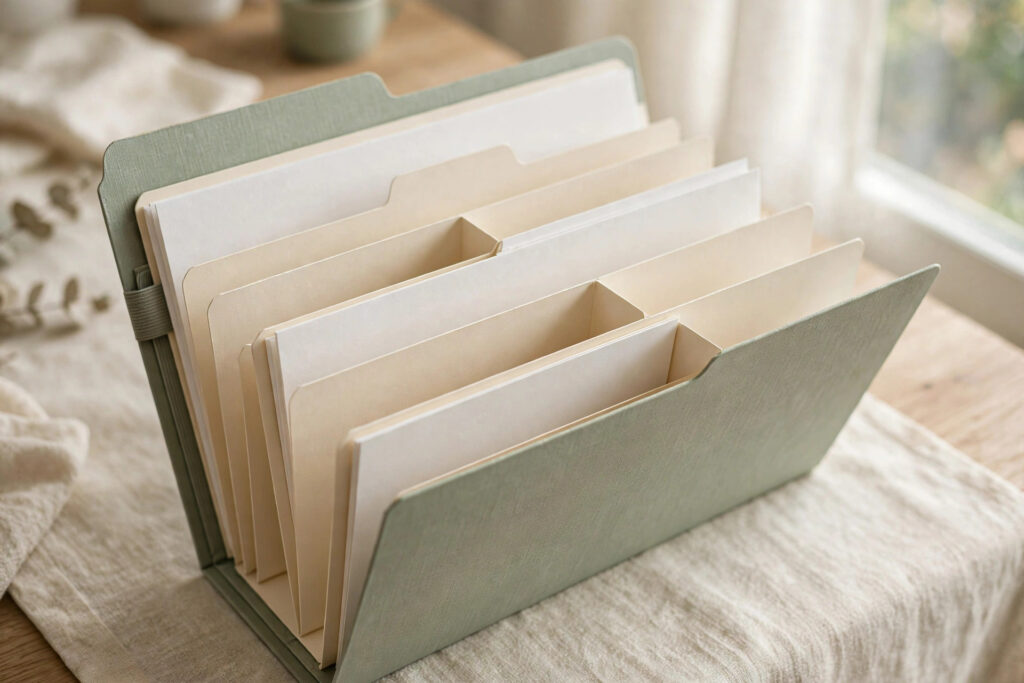
One slim folder or expanding file with 4–6 sections: Appointments & tickets, School, Health admin, Home (lease/insurance summaries), Menus & local. Keep it where the household actually looks — near the kitchen calendar, not in a spare room. Its smallness is the feature: when a
section bulges, the oldest items get re-judged (usually straight to recycle).
3. The archive box (out of sight, by category)
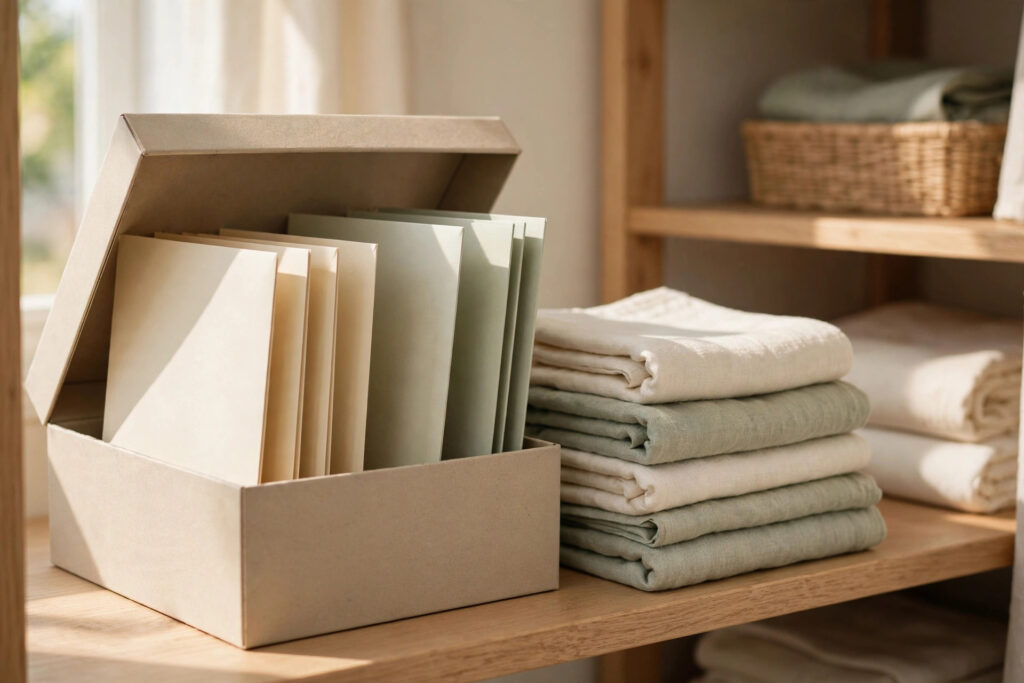
One box or crate with simple hanging folders or envelopes by category: Identity & certificates, Home & tenancy, Work & tax, Warranties & manuals, School records, Sentimental (small). This box lives in a closet or under a bed — deliberately not on a surface. Most of its contents will be touched once a year or less; the two rules are that categories fit on one hand-written list taped inside the lid, and anything going in takes under a minute to retrieve later.
A note on manuals: most appliance manuals are available as PDFs from the manufacturer in about a minute. Keep the paper manual only if the appliance is old, the PDF is hard to find, or you write your own notes in it. Store the purchase receipt (or a photo of it) with the warranty
folder — the receipt is usually worth more than the manual.
The daily 2 minutes and the weekly 15
Daily (2 minutes, tied to post arriving): stand over the tray, apply the 4 verdicts to everything that arrived, recycle at the door if you can. Two minutes daily is what stops a pile ever being born.
Weekly (15 minutes, same time each week): empty the action tray by actually acting — pay it, book it, sign it, or consciously schedule it. Then a fast pass through the reference folder: anything whose date passed moves to file or recycle. Tie it to an existing weekly moment (Sunday evening, after the weekly shop) and to your 10-minute nightly reset week so the two routines hold each other up.
Households with school paper
School paper deserves its own mini-system because it arrives emotionally loaded. Per child, one folder with two sections: Now (permission slips, this term’s schedule — lives in the reference folder’s School section or the school command centre) and Keep for now (report cards, certificates). Artwork is a separate decision with its own system — see kids’ artwork without the guilt pile. Rule of thumb: if it won’t matter at the end of the school year, it gets photographed and recycled at term’s end.
Going digital where it actually helps
Photos of receipts and letters are fine for everyday reference, but be honest about limits: some bodies (insurers, officials, schools) sometimes ask for originals of certificates and contracts — keep paper originals of the keep-forever category even if you also scan them. Scan-to-file helps most for warranties and manuals (photo the model plate too). Do not let “I should scan everything” become a new pile of its own: paper first, scanning only where it earns its time.
What to skip
- A folder per sender / per bill / per child per subject. Systems with 30 categories die of their own administration. Six categories you use beat thirty you maintain in theory.
- Keeping paper “for the information.” Information lives online; keep paper only for proof, signatures, or sentiment.
- The second “temporary” tray. The moment a second landing spot is allowed, the system has two piles instead of one decision point.
FAQ
How long should I keep bills and statements?
This varies by country and situation, and specific retention rules are a matter for official guidance in your country — we don’t give financial or legal advice. The organizing answer: keep what your official sources require, in the archive box by year, and recycle the rest on schedule. If you’re unsure about something, keep the paper until you’ve checked an official source.
What about really important documents — passports, certificates?
Originals of identity and legal documents should be kept securely (a fire-resistant box is a sensible upgrade) and they never live in the daily tray. This guide organizes paper flow; for storage of valuables, follow official guidance for your documents.
My partner dumps mail on the counter. How do I get buy-in?
Move the tray to the exact counter spot where the dumping happens (homes must go where paper lands — see why systems fall apart), and agree on the single weekly 15-minute slot together. One tray, in the right place, converts most dumpers.
I have years of backlog. Where do I start?
Not with the backlog. Set up the three containers and run the system forward for two weeks so new paper behaves. Then attack the backlog in 20-minute sessions, oldest pile first, with the recycling bag beside you — most of it will be verdict 4.
2 thoughts on “Paper Piles, Sorted: A Simple Home Paper System (Bills, School, Manuals)”