

[AFFILIATE DISCLOSURE] This guide may contain affiliate links. If you buy through them, StaysTidy may earn a commission at no extra cost to you. Read our Affiliate Disclosure.
No vanity cabinet, no linen cupboard, a pedestal sink and a landlord who says no to drilling: the no-storage bathroom is the default bathroom in rentals and small homes. The floor space is gone before you start — so this guide works the other two dimensions: up (walls, doors, the air above the toilet and the bath) and in (inside containers with hard limits). Ten ideas, all freestanding, over-door, tension or removable — with the honest failure modes, because a bathroom is wet, steamy and unforgiving to products that work fine in a dry hallway.
These ideas sit inside our Entryway, Living & Bath: First Steps, Calm Rooms systems, where every small room has to work with the shell it was given.
Measure first (the wet-room edition)
- Door: hinged? Does it open fully flat? Over-door ideas live or die on this. Measure hook clearance at the top of the door frame.
- Above-toilet wall height: from the cistern top to the ceiling — this is a full storage shelf’s worth of air in most bathrooms.
- Bath rim and shower edges: width of the bath rim, and whether the shower is over the bath or a cubicle (decides caddy style).
- The pedestal zone: floor footprint beside and around the pedestal — slim carts live or die on these centimetres.
- Radiator/towel rail position: heat sources limit what can hang near them (aerosols and heat are not friends — keep pressurized cans away from heat, check can labels).
- Steam reality check: is there an extractor fan, a window, or neither? Poorly ventilated bathrooms punish fabric, untreated wood and cheap adhesives. Choose accordingly.
The 10 ideas
1. Over-door rail with hooks (towels and robes)
The back of the bathroom door is the largest unused surface in the room. A hook rail there holds the daily towels and robes — and unlike a towel ring it needs no wall. Rule: towels on hooks dry slower than on bars; in a steamy bathroom, rotate and air the room, or hooks become a damp-towel museum. If your bathroom has no fan or window, prioritize a freestanding towel ladder (idea 6) near the room’s airflow instead.
2. Over-toilet freestanding shelf unit
The frame that stands over the cistern turns dead air into 2–3 shelves: spare toilet rolls, the cleaning caddy, a basket of guest towels. Measure the cistern clearance carefully — you need access to the flush and, occasionally, the inside of the tank. Units that block maintenance access are a landlord problem waiting to happen; choose one you can slide out.
3. Shower caddy that hangs from the shower head or a tension pole

Hanging caddies keep bottles off the bath rim. Honest limits: head-hung caddies swing and stress the fitting if overloaded — keep to daily bottles, not the whole collection. In a cubicle, a corner tension-pole caddy uses vertical space without sucking onto tiles (suction fails in steam eventually; treat all suction as temporary).
4. Slim rolling cart beside the pedestal
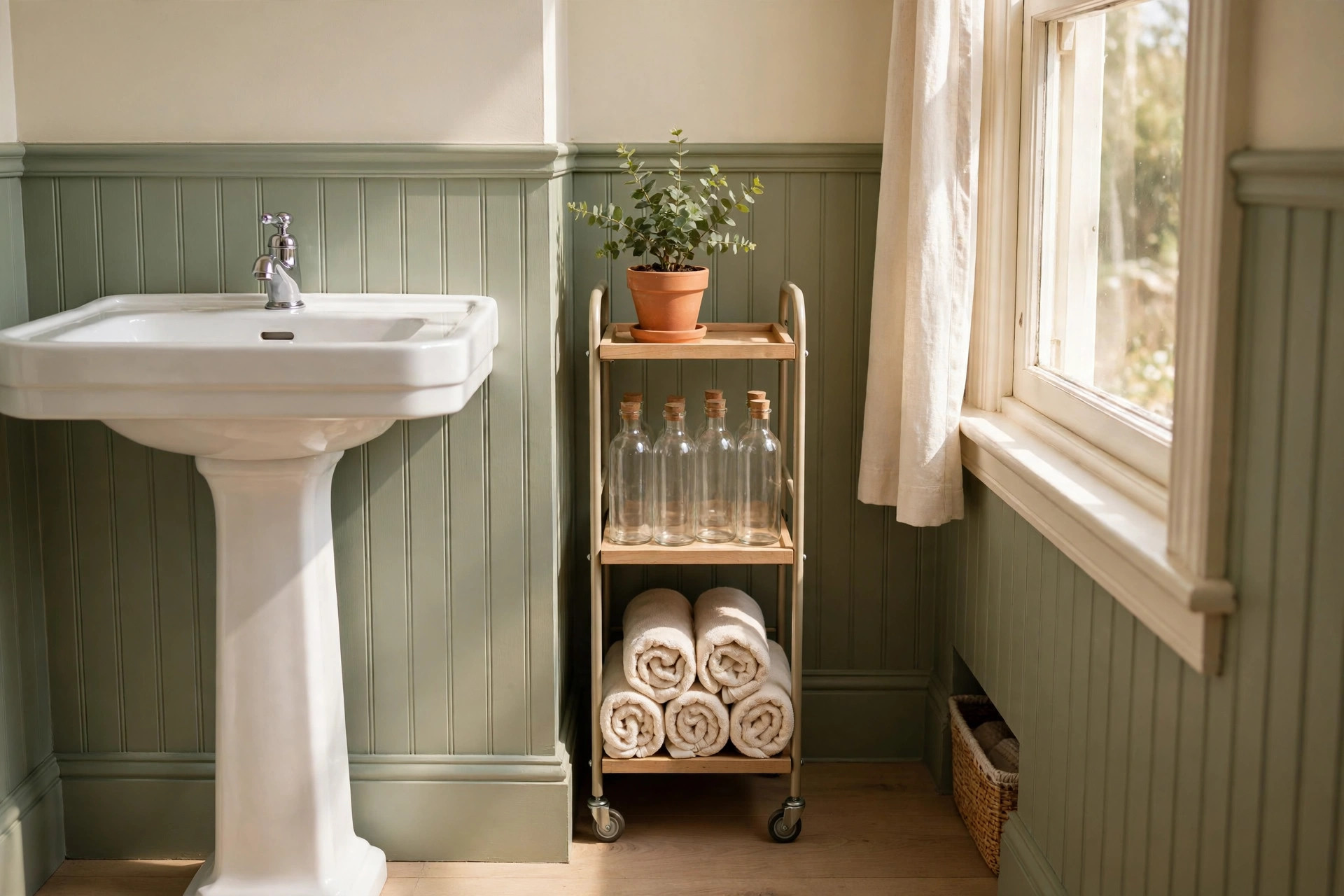
A 5–7 inch (13–18 cm) cart in the pedestal’s side gap holds hair tools, skincare and cleaning supplies, and rolls out for use. In wet rooms, metal or plastic beats fabric baskets; check castors will survive a wet floor or choose a static slim stand instead.
5. Over-cabinet-door caddy — if you have any cabinet at all
A mirrored cabinet door or under-sink door takes a hanging caddy inside for brushes, cotton and small bottles. Measure the door-close clearance before buying (the same rule as kitchen cabinet doors in our rental kitchen guide).
6. Freestanding towel ladder or stand
A leaning ladder (weighted or against the wall, no fixings) or a standing towel rail gives towels the airflow hooks can’t. In rentals, a stand is the safer option — leaning ladders can scuff paint, which is deposit money; felt pads on contact points reduce the risk.
7. Baskets on the over-toilet shelves, one job each
Open shelves without baskets become a display of chaos. One basket = one category: hair, skin, cleaning, guest. Hard capacity again — the basket decides how much “hair stuff” exists in this house.
8. Magnetic or adhesive strips inside the cabinet door
For bobby pins, tweezers and nail tools, a magnetic strip inside a cabinet door ends the drawer dig. Adhesive honesty rules apply: removable strips, smooth clean surfaces only, light items, and never on painted rental surfaces you can’t repair. No cabinet? The inside of a storage-box lid does the same job.
9. A lidded box for the “stock” shelf

Spare toothpaste, cotton refills, the second shampoo: back-stock belongs in one lidded box on the highest shelf, exactly like the pantry’s back-stock zone (see our 7-zone pantry system). One box; when it’s full, you are stocked — sales cannot talk you into a second.
10. Door-back clear pockets for small families of things
A clear over-door pocket organizer takes medicines-adjacent basics (plasters, thermometers — stored per their own label instructions and out of young children’s reach), hair ties, cotton pads. Visibility is the organizer. Keep anything a child shouldn’t reach up high or in the lidded box instead — storage height is a household decision we won’t make for you.
What to skip
- Suction-cup shelves as permanent storage. In steam, they all eventually let go — usually at night, loudly, with bottles. Suction is for travel.
- Untreated bamboo/wood in a fan-less steamy bathroom unless you accept blackening and replacement cycles. Plastic and coated metal survive the climate.
- Storing towels you own but never use here. Bathroom storage this scarce is for the weekly rotation only; the archive of towels belongs in the linen system.
- Anything screwed, glued or “permanent” in a rental — every idea above leaves with you.
Keep it tidy
The bathroom enters the nightly reset as a one-minute station: products back in baskets, towels hung, stock box closed. Weekly: wipe the cart and caddy (soap scum is the silent organizer-killer), check the suction items before gravity does, and evict empties — bathrooms accumulate finished bottles like no other room.
FAQ
There’s genuinely no wall space either. What’s the minimum?
Over-door hooks (idea 1) + slim cart (idea 4) + one lidded stock box. Three elements cover towels, daily products and back-stock in almost any bathroom ever built.
Will an over-toilet unit annoy my landlord?
It’s freestanding furniture; it touches nothing. The real requirement is maintenance access — pick a unit you can move in seconds, and never box in pipework or stopcocks.
How do I stop the shower caddy going rusty and grim?
Choose rust-resistant finishes honestly rated for wet use, keep only daily bottles in it, and wipe it in the weekly pass. A caddy with twelve bottles is a stock shelf with worse access — stock belongs in the box (idea 9).
Kids’ bath toys everywhere — where do they fit?
One mesh or perforated basket that lives in the bath and drains, emptied into the over-toilet basket zone when adults shower. Toys get the same hard-capacity rule: the basket decides.