

Every December, the same scene plays out in small homes everywhere. The wrapping paper rolls are somewhere — behind the coats, under the bed, in the bag behind the door where they have slowly been crushed into soft corners and torn edges. You buy a new roll because the old one looks too tired, wrap presents on the floor because no surface is free, and the tape lives in a different room from the scissors.
Then January comes, and the whole mess gets shoved back into hiding for another eleven months.
The fix is not more space and it is not a dedicated craft room. It is two small decisions: a gift-wrap station that fits the home you actually have, set up before the December rush — and a storage system that keeps rolls, bags and ribbon intact and findable the rest of the year. Wrapping paper storage for small and rented homes: no drilling, no furniture bought for the job.
First, the honest count
Before you store anything, gather every wrapping supply you own into one pile — every roll, gift bag, tissue pack, ribbon spool, tag and bow, from every hiding place. Most people are surprised twice: by how much they have, and by how much of it is damaged.
Sort the pile with a cold eye:
- Keep: rolls with enough un-crushed length to actually wrap a box, bags that are not torn or creased across the front, ribbon you would genuinely use.
- Demote: part-used rolls and slightly tired bags become this year’s use-first supply — for family, for the post, for the awkward shapes — not stored as treasure.
- Let go: the last 30 centimetres of five different rolls, the crushed bows, the bag with the broken handle. This is the one-in, one-out rule doing its quiet work — the same one in, one out system we use in every room: keep the pile you would buy again today.
Measure your longest roll while everything is out. Rolls are longer than most people expect, and that one measurement decides which options below are even possible. Every failed gift wrap storage setup fails at this step: a lovely container bought first, rolls that did not fit discovered second.
The December station: pick your footprint
A wrapping station is not a room or a table. It is one defined place where everything for wrapping lives together for the month — rolls, bags, tape, scissors, tags, a pen — so wrapping a present is a five-minute job instead of an archaeological dig. Choose the footprint your home can honestly give:
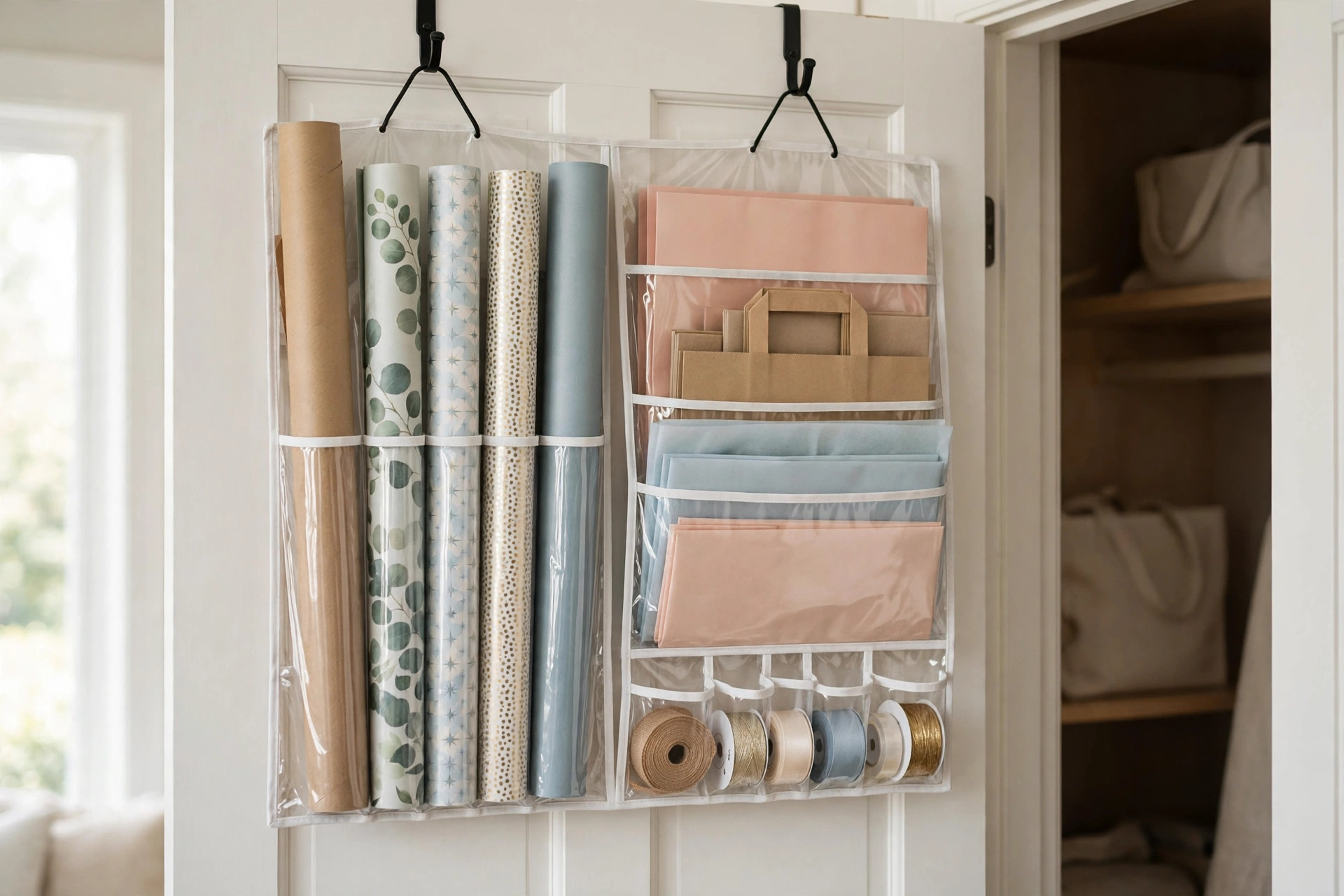
The door station. The back of a closet or bedroom door is the most underused vertical space in a small home. A clear over-door organizer with long pockets holds rolls upright where you can see every pattern at once, with smaller pockets for tape, tags and scissors. A hanging gift wrap organizer does the same job in one piece, and over-door hooks need no screws and leave no mark — renters, take note. This is vertical wrapping paper storage doing double duty — the station in December, the storage all year.
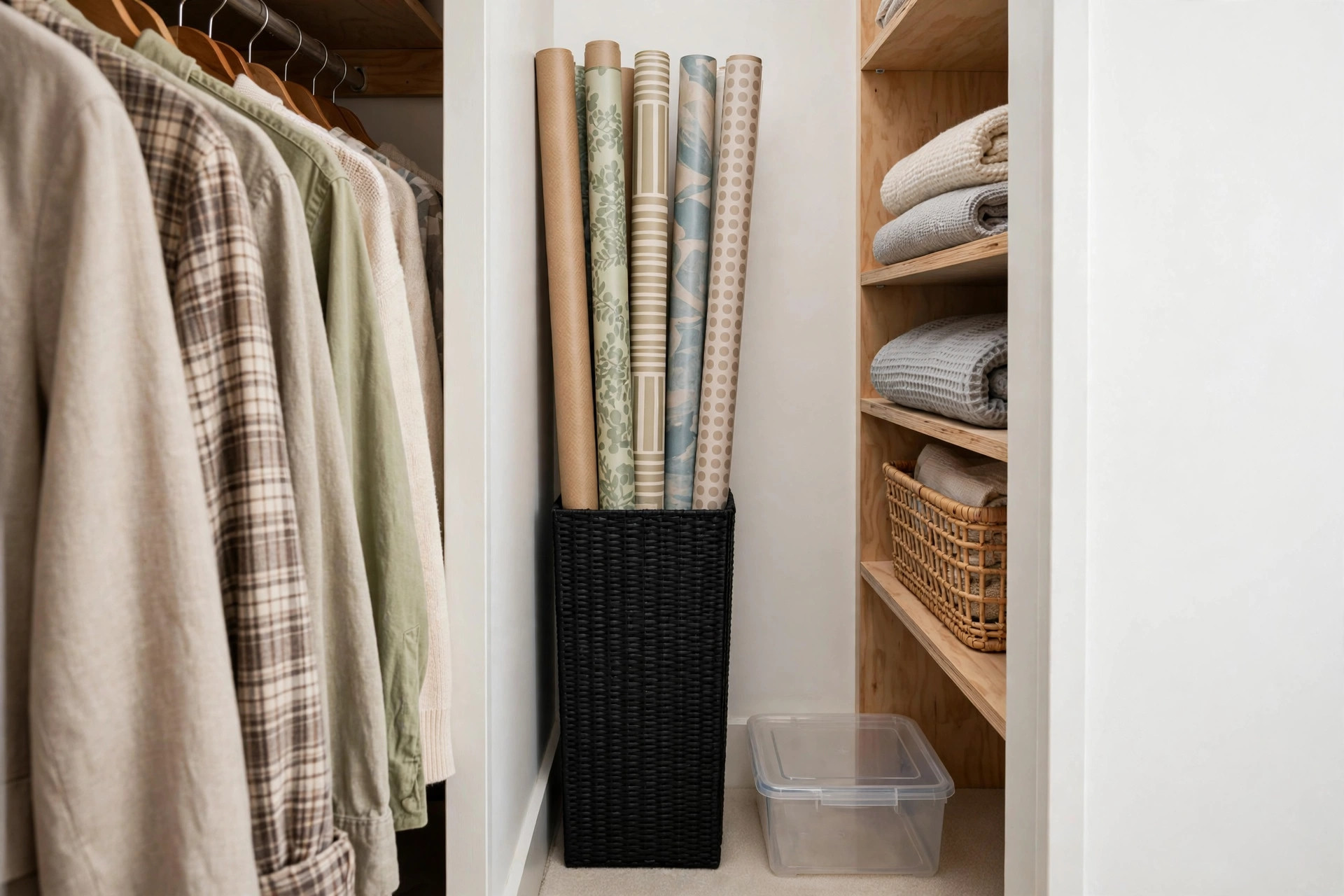
The closet sliver. Most closets have a dead 15–20 centimetres at one end where nothing fits except — exactly — a row of rolls standing on end. Stand them in a tall, narrow bin or a storage box so they cannot slump and bend, add one small caddy for ribbon and tape on the shelf above, and the sliver becomes the station.
The under-bed tote. One low, flat box under the bed: rolls lying flat, a pouch of bags and tissue on top, a small container for ribbon, tags and tape at one end. Slide it out, wrap on the bed or floor, slide it back. For homes with no spare closet, underbed wrapping paper storage costs zero living space — which is why it earns a full section below.
The single tote. The smallest honest station: one tote bag or one box, everything in it, carried to whatever surface is free. A tote with rolls standing in it and a zip pouch for the small things beats a “system” spread across four cupboards, every time.
Whichever footprint you choose, the rule is the same: one home for all of it. Ribbon in a kitchen drawer and tags in a desk is not a station — it is a scavenger hunt.
Storing the rolls: the other eleven months
Rolls are awkward in one specific way: long, light, and determined to unroll, slump and crush. Every good system answers those three problems.
Standing up (vertical). Rolls stored upright in a tall bin, a wrapping paper storage box, or a gift wrapping paper storage bag stay in the best condition: nothing rests on them, they cannot roll around, and you can see each pattern without pulling anything out. Vertical is the first choice wherever you have the height — a closet corner, the end of a wardrobe. Two details matter: keep rolls snug enough that they cannot lean and bend (a half-empty tall bin is a bending machine; pad the gap with the gift bags), and tame the loose ends — a strip of low-tack tape, a paper clip, or an empty kitchen-roll tube slipped over the roll stops the slow unroll that wrecks edges over a year.
Lying flat. If vertical height does not exist in your home, flat is the honest alternative — this is what under-bed storage does well. A long, low box protects rolls from dust and from things piled on top of them; rolls in a single layer do not crush each other. What flat storage cannot survive is weight: the moment the box becomes the bottom layer of a stack, the rolls are done for. One layer, lid on, nothing on top of the box itself.
What to avoid. Loose rolls in a damp garage or attic (paper drinks in moisture and the colours bleed), rolls against rough surfaces, and the classic: rolls left in the thin shop bag behind a door, where every opening takes another bite out of them. A wrapping paper organizer does not need to be fancy — just a rigid or padded boundary between your rolls and the rest of your home’s chaos.
The small stuff: bags, tissue, ribbon and tags
Rolls get the attention, but the small supplies are what make wrapping sessions fall apart. Give them one container — a shoebox, a small caddy, one section of the tote — and one rule: it all lives there, or not at all.
- Gift bags: store flat, nested inside each other by size, largest at the back. A file-style holder or one side of your storage box keeps them uncreased. Bags stored flat take almost no space; bags stored stuffed take a cupboard.
- Tissue paper: keep it in its packet, flat, with the bags. White and one or two colours is genuinely enough — tissue is a supporting act, not a collection.
- Ribbon: spools stay on their cards or thread onto one dowel or tension rod inside your container, so ends cannot tangle into the famous ribbon knot. Keep curling ribbon and fabric ribbon separate — they behave differently and tangle enthusiastically.
- Tags, tape, scissors, pen: one small pouch. This pouch is the heart of the system — the thing carried to the wrapping surface, and the thing that makes wrapping one present a calm job instead of a house-wide search.
Keeping the small stuff together is most of what wrapping paper organizing actually is. The rolls are one decision; this pouch is the daily habit.
The January reset: pack-away that pays you back
The week after Christmas is when next December is won or lost. Twenty minutes of pack-away — the same post-holiday reset thinking as a kitchen restock after the holidays — and the system survives to be useful again.
- Sort before you store. Keep rolls with a real amount left, demote tired ends to the use-first pile, let the scraps go. Reused gift bags get flattened and nested now, not in December.
- Note what ran out. Tape, tags and one colour of paper always run out first. Write it on a card and keep the card in the pouch. Next November, that card is your shopping list — no guessing, no duplicates.
- Pack the Christmas wrap together. Your christmas wrap storage should be one identifiable place — one box, one bag, one end of the shelf — with the seasonal paper, bags and the card inside it. Come December, you lift out one thing and the station is halfway built.
- Store it where December-you will look. Not the far corner of the attic. The top of the closet, the under-bed box, the shelf above the coats — wherever your hand goes first when you think “wrapping”. xmas wrapping paper storage that cannot be found is just clutter with good intentions.
Done properly, January’s pack-away means next December starts at step five instead of step zero.
Five mistakes that undo good storage
- Buying the container before measuring the rolls. The single most common failure. Measure first; shop second.
- Storing rolls where doors, feet or other boxes hit them. Crushed corners are not bad luck; they are an address. Move the rolls to a protected boundary.
- Spreading supplies across the home. Tape in the kitchen, tags in the desk, ribbon in a bedroom drawer. One home for all of it, or the station does not exist.
- Keeping every scrap. A box of tired ends and broken bags makes the good supplies harder to see and use. Keep what you would buy again; let the rest go.
- No January sort. Packing away in a rush means opening damaged, duplicated supplies next December and buying more of what you already own.
FAQ
How do you store wrapping paper in a small apartment?
Choose one footprint and give everything to it: a door organizer for vertical storage, a tall bin in a closet sliver, or one flat box under the bed. Stand rolls upright where you have height, keep them snug so they cannot bend, and put all the small supplies in one pouch or caddy in the same place. Storing wrapping paper well in a small home is about one home for all of it, not about finding more room.
What is the best way to store gift wrap so it doesn’t get crushed?
Upright and protected. Rolls standing in a rigid box, tall bin or storage bag, with nothing resting on them and loose ends taped or clipped, come out in the best condition. Flat storage works too — one layer in a lidded box, nothing stacked on top. What crushes paper is weight, leaning and damp, so any gift wrap vertical storage setup that removes those three will serve you well. More small-space systems live in our closets and wardrobes hub.
Can you store wrapping paper under the bed?
Yes — for many small homes it is the best option, because it costs no living space. Use a long, low box with a lid so the rolls stay clean and flat, keep it to one layer, and store the pouch of small supplies at one end of the same box so the whole station slides out together. Avoid it only if the space is damp or the box would end up buried under other storage.
How do I organize gift wrap, bags and ribbon together?
One container, sections by job: rolls standing or lying along the length, gift bags flattened and nested by size at one side, tissue kept in its packet with the bags, ribbon spools together on their cards or a single dowel, and tape, tags, scissors and a pen in one small pouch. When everything shares one box or tote, wrapping means carrying one thing to the table.
When should I sort and organize my Christmas wrapping paper?
Twice a year, briefly. Once in late November, when you set up the station and see what needs replacing before the shops get busy — and once in early January, when you pack leftovers away sorted and note what ran out. Twenty minutes each time is genuinely enough.
Small supplies, one home, calm Decembers
Wrapping paper will never be the biggest organizing problem in your home — but it might be the most seasonal one, arriving in a rush every December and punishing every household that stored it badly in January. One station that fits your actual rooms, rolls standing or lying protected instead of crushed, the small stuff in one pouch, and a short sort at each end of the season: that is the whole system.
Planning the January reset on paper? The free checklists in the StaysTidy Printable Library — including the 10-Minute Nightly Reset — are built for exactly these small, finishable sorts.



1 thought on “Wrapping Paper Storage for Small Homes: A Station for December, a System for the Other 11 Months”