
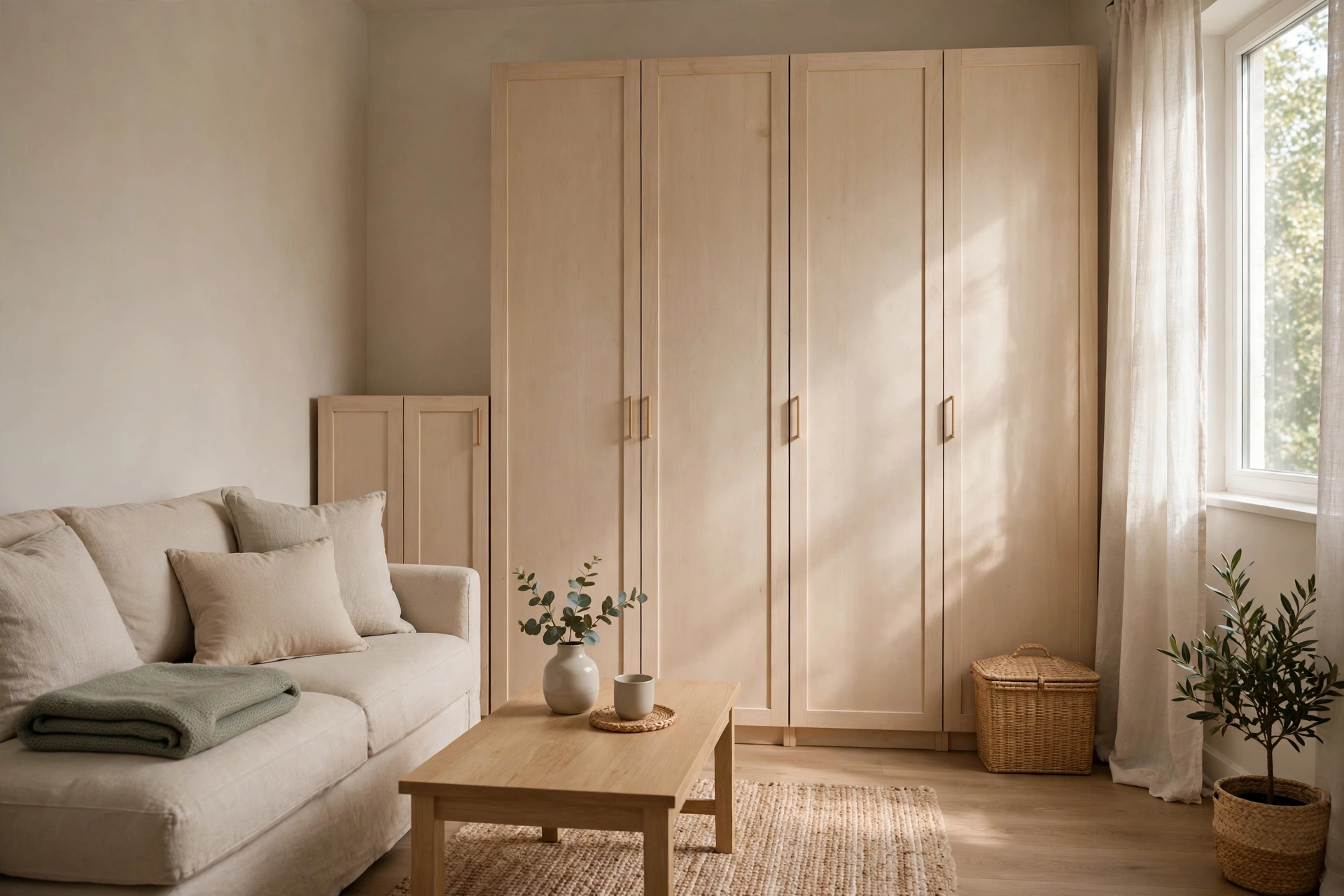
Most living rooms look fine at ten in the morning and quietly fall apart by eight at night. Not because anyone is untidy — because four specific things have no real home: charging cords, remotes, blankets, and the daily pile of post, bags and bits that lands on the first flat surface. Give those four a home that’s closed, close to where they’re used, and easy enough to use when you’re tired, and the room mostly stays done.
The principle underneath all of it: storage that disappears beats storage that displays. Open baskets of clutter still look like clutter. Lids, doors and drawers are what make a room read as calm — and point-of-use placement is what makes anyone actually put things away.
1. The daily pile: give it a boundary, not a ban
The pile — post, keys, a bag, something to return — is not a character flaw. It’s an entryway problem arriving in the living room. The long-term fix is a proper landing system where you walk in; our entryway drop zone guide builds that in about an hour. Until then, give the pile one bounded home: a single tray or lidded basket on the sideboard or by the door, and a household rule that the pile may live there and nowhere else. Bounded clutter is invisible clutter; the same three items spread across three surfaces is what makes a room look messy. Sort the tray weekly — five minutes, standing up, bin beside you.
2. Cords: one charging home, off the floor
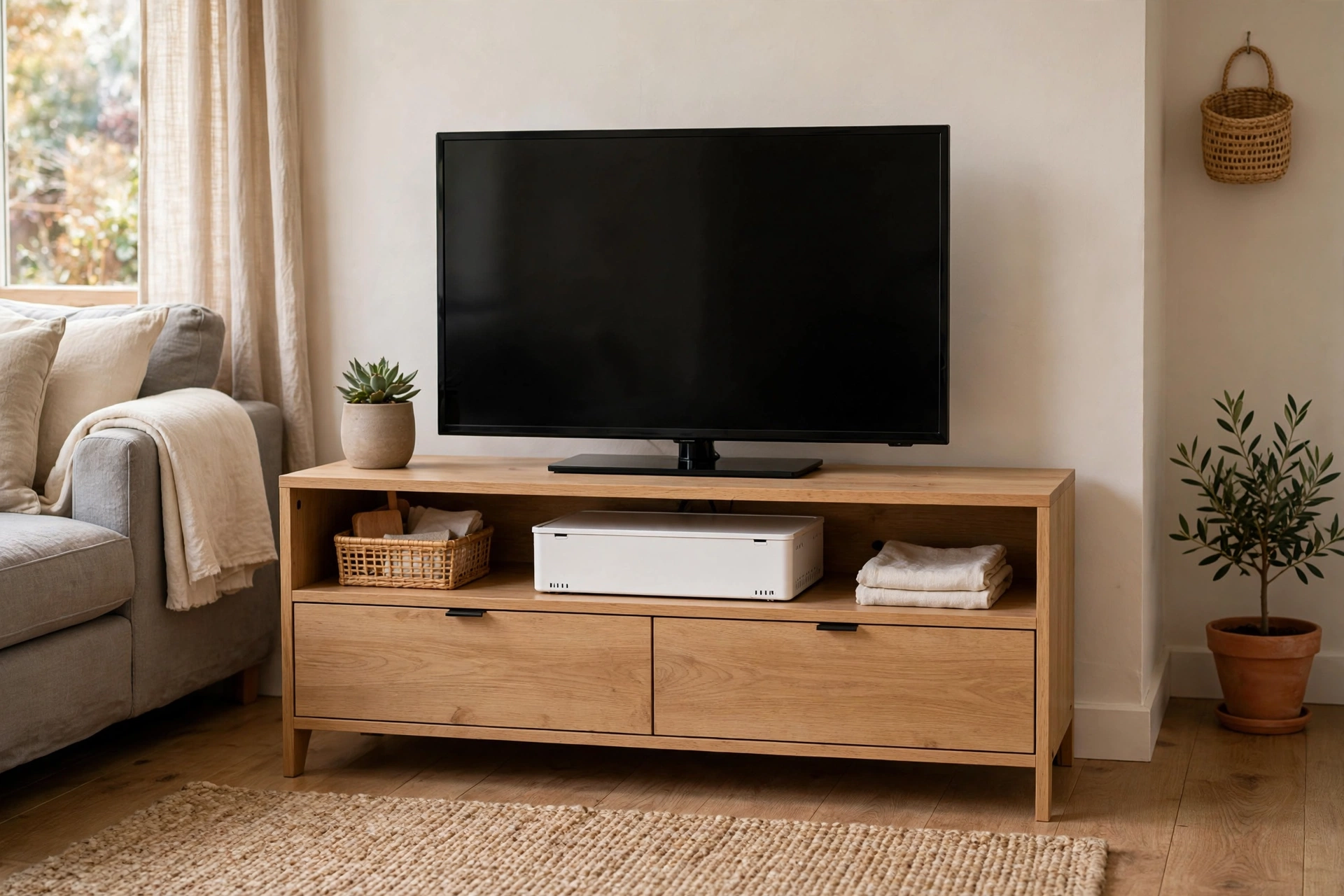
Cords look worst on the floor and multiply on every surface. Pick one charging home — a lidded basket or a box on the shelf nearest the sofa is usually right — and route every charger to it. Loose cables get one wrap or clip each so they stop tangling into a nest. Two small habits do the heavy lifting: every device charges in the same place, and a cable that leaves the home (for work, for travel) gets replaced the same evening. If your living room is also your bedroom and office, treat the charging home as part of your sleep zone rather than your work zone — the studio apartment zones guide shows how to draw those boundaries in one room.
3. Remotes: one tray, within arm’s reach
Remotes wander because their “home” is wherever they were last dropped. Fix it with one tray, dish or small caddy on the side table — close enough to reach without getting up, because a storage spot you have to stand for is a storage spot that won’t be used at 9pm. Every remote, every night, back on the tray. It’s a two-second habit once the tray exists, and it ends the cushion excavation for good.
4. Blankets: closed, one per seat
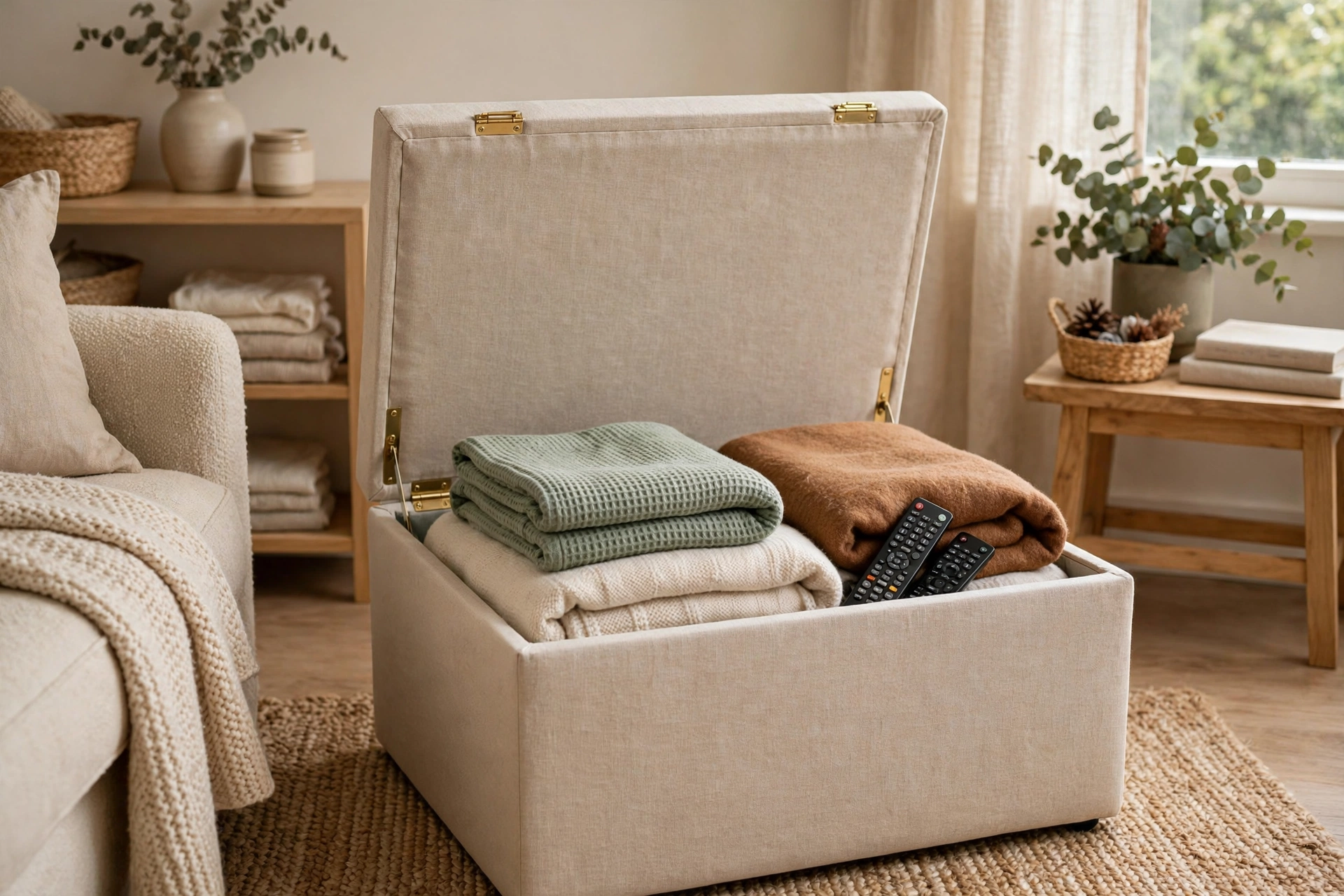
Throws draped over every arm look cosy in photos and chaotic by Friday. Keep one blanket per seat actually in use, folded into closed storage — a storage ottoman, a lidded basket, or a drawer — and put the spares in the bedroom. The room instantly reads calmer, and the blanket you do keep out can be the nice one.
The surfaces rule that ties it together
Once the four homes exist, protect them with one simple standard: the coffee table holds at most three things (say, the remote tray, a book, a drink), and the sofa arms hold nothing. Surfaces are what the eye reads first; clear surfaces make the whole room look organised even when a drawer somewhere is not.
A 20-minute starter pass
| Step | Action | ~Time |
|---|---|---|
| 1 | Put one tray where the daily pile usually forms | 3 min |
| 2 | Gather every charger to one lidded basket or box | 7 min |
| 3 | Place the remote tray on the side table | 2 min |
| 4 | Fold blankets into closed storage; one per seat stays out | 5 min |
| 5 | Clear the coffee table to three things | 3 min |
Mistakes that bring the mess back
Open storage everywhere. Open baskets show their contents. In the room where you relax, choose lids and doors; save open storage for cupboards.
Homes too far from use. A charger box in the hallway cupboard loses to the floor by the sofa every time. Storage must live within reach of where the thing is used.
Too many categories. If putting something away requires a decision, it goes on the table. Four homes, no sub-sorting — that’s the whole system.
None of this needs new furniture or a bigger room. It needs four closed homes, placed where life actually happens, and a week of putting things back until it sticks.



2 thoughts on “Living Room Storage That Disappears: Cords, Remotes, Blankets and the Daily Pile”