
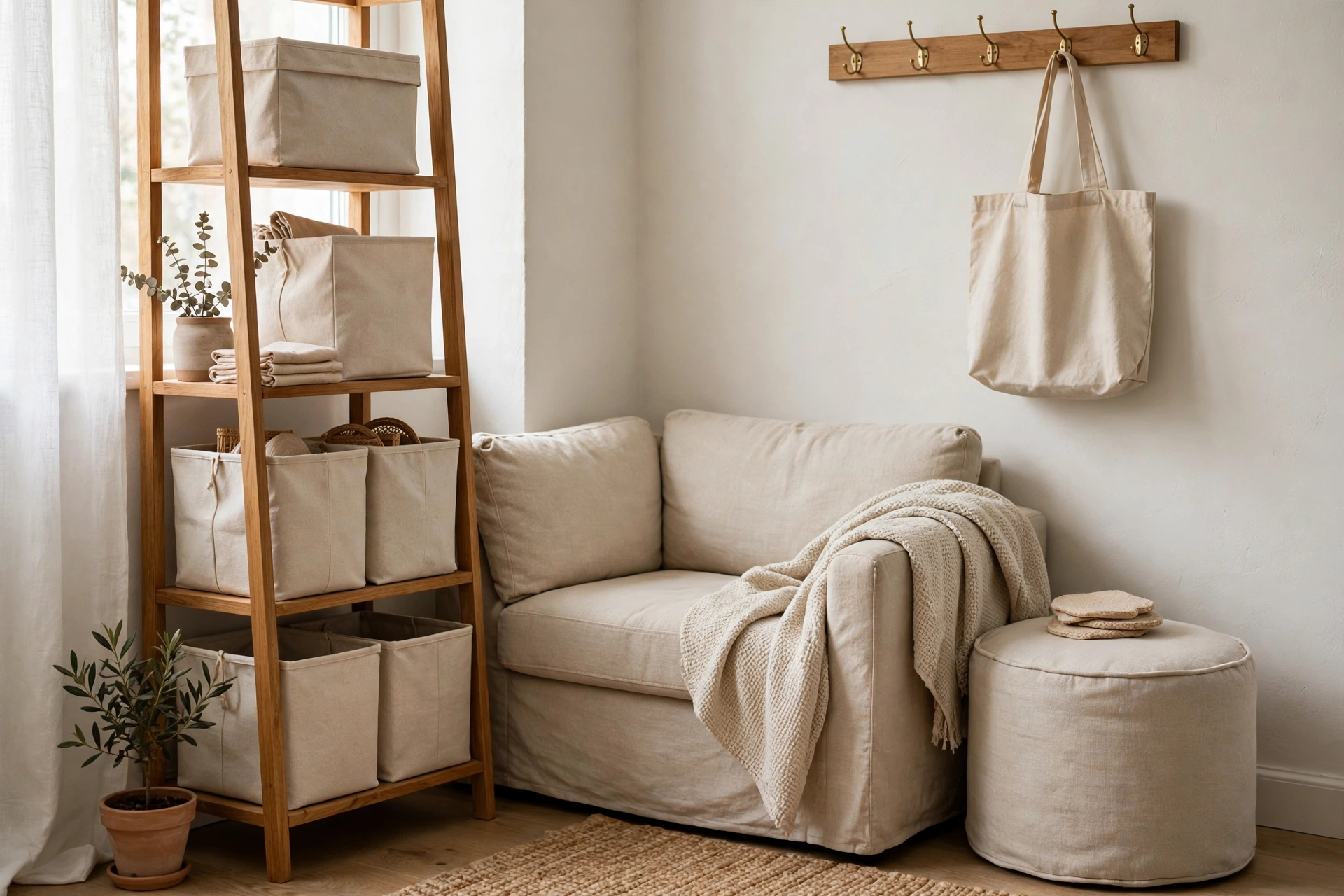
The best storage ideas for small rooms all follow one rule: everything in the room has to earn its place twice. A shelf is not just a shelf — it is a shelf and a room divider. A bin is not just a bin — it is a bin and a side table. A bed is not just a bed — it is a bed and a wardrobe.
Small rooms punish single-purpose furniture and reward anything that does two jobs. This is the whole system: go vertical, choose furniture that stores, pick bins that actually work, and skip the bulky solutions that eat the floor you are trying to save.
The rule: everything earns its place twice
Before buying anything, ask one question of every object in the room: what two jobs does it do? A storage ottoman holds blankets and gives you a seat. A tall narrow shelf holds books and uses the wall, not the floor. A lidded box holds the winter clothes and doubles as a side table.
If something does one job and takes up floor space, it is a candidate for leaving the room. Small rooms are not short of space in the way people think — they are short of surfaces that do double duty. Fix the double duty first, and the room feels twice as big without moving a wall.
The best storage ideas for small rooms go vertical
The floor is the most expensive surface in a small room. The wall is free. The best storage ideas for small rooms start by moving things up.
Tall, narrow shelving. One tall narrow unit holds as much as three short wide ones and takes a fraction of the floor. Put the daily things at eye level, the weekly things above, and the seasonal things at the very top, where a step stool earns its keep once a season.
Over the door. The back of a door is a whole shelf nobody uses. Over-door racks hold shoes, cleaning supplies, scarves, or pantry overflow — and they need no screws, which matters in a rental where the deposit depends on the walls staying intact.
Wall-mounted racks and hooks. Coats, bags, hats, headphones — the things that end up on chairs and floors live better on hooks. A row of hooks by the door ends the daily pile in a way no amount of tidying ever does, because the pile was never a tidying problem. It was a home problem: the coats had nowhere to live.
The top of the room. The shelf above a door frame, the top of a wardrobe, the space above the kitchen cabinets — these are the places seasonal and rarely-used things belong. They are out of the way without being out of reach, and they cost nothing.
Furniture that stores: the best storage solutions for small furniture
The best storage solutions for small furniture are the pieces that hide things in plain sight.
The storage ottoman. It is a seat, a footrest, a side table and a blanket box. In a small living room it replaces three separate objects with one — and the blankets inside it are the reason the sofa looks tidy instead of buried.
The bed with storage. Under-bed drawers or a lift-up base turn the largest piece of furniture in the bedroom into the largest storage in the bedroom. Out-of-season clothes, spare bedding, the things you need twice a year — they live under the bed, not in a pile on top of a wardrobe.
The bench with a lid. An entryway bench that opens is a shoe cupboard you can sit on. A window bench with storage underneath is a reading nook and a toy box. The lid is the difference between storage and a surface that happens to hold things.
The side table with a drawer. A small table that holds one drawer holds the remote, the charger, the notebook — the small things that otherwise spread across every flat surface in the room. One drawer per table is enough; the point is that the small things have one home each.
Bins that actually work
Bins fail in small rooms for one reason: the wrong bin for the job. These are the three that earn their keep, and how to choose between them.
Canvas storage bins. Soft, light, and forgiving — canvas storage bins fit shelves that rigid boxes do not, and they look like part of the room instead of a warehouse. They are the right bin for clothes, toys, linens and anything soft: things you reach for often, in a place people see. They do not stack well when full, and they do not protect against damp — keep them indoors and off the floor.
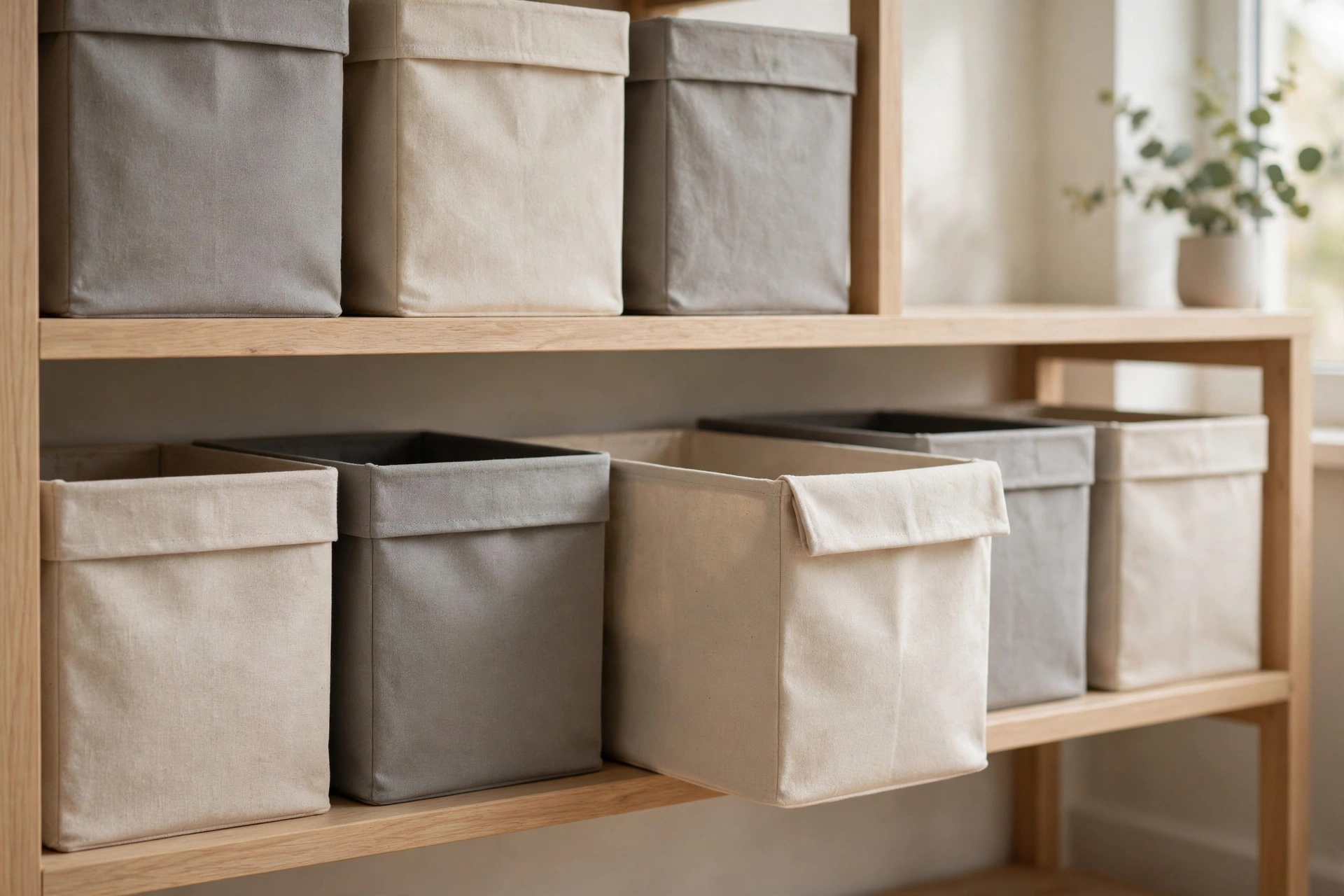
Stackable metal storage bins. Rigid, stackable, and honest about their limits — stackable metal storage bins are the right bin for the garage shelf, the closet top, the things that need to survive being stacked three high. They protect against crushing and damp far better than fabric, and they stack without a lid sliding off. They are heavier and louder than canvas, so they belong where they are seen least.

Lidded boxes. The lid is the whole point: lidded boxes keep dust off, keep the contents in, and let you stack without a collapse. Use them for anything you touch less than once a month — seasonal clothes, keepsakes, the cables and chargers nobody can throw away. A box without a lid is a basket; a box with a lid is storage.
How to choose a storage container. Match the container to the job, not to the shop display. Soft things, often reached for, in a visible place: canvas. Heavy things, stacked high, in a hidden place: metal. Rarely touched, must stay clean: lidded. And one rule for all three: measure the shelf before you buy the bin. A bin that does not fit the shelf is not storage — it is a new problem, standing on the floor.
Small-room zones: where it all goes
Storage is not one system for the whole home. It is a small system per zone, and each zone has one trick.
The entryway. Hooks for coats, a bench or box for shoes, one tray for keys and post. The entryway holds the things that leave the house — so it needs to be the easiest zone to use, not the tidiest-looking one. If the shoe box is hard to open, the shoes go on the floor.
The bedroom. Under the bed for seasonal things, one drawer for the daily things, hooks on the back of the door for tomorrow’s clothes. The bedroom stores best when the morning routine has a place: the clothes for tomorrow, hung tonight, end the morning hunt through drawers.
The living room. One storage ottoman, one lidded box per shelf, and a rule: nothing lives on a flat surface that does not belong to that surface. The living room is where clutter gathers because it is where life happens — the storage has to be as easy to use as the floor is.
The kitchen corner. A tall narrow shelf for the overflow, stackable bins for the dry goods, hooks inside a cupboard door for the measuring cups. Kitchens in small homes fail on counter space, not cupboard space — so the storage goes up and into the doors, and the counter stays clear for cooking.
What to skip
Some storage ideas cost more floor than they save. Skip these in a small room:
Bulky freestanding units. A wide, deep cupboard that holds a lot and eats a wall is a bad trade in a room that has one wall to spare. Tall and narrow beats wide and deep, every time.
Open piles with no container. A pile is not storage. If it has no bin, no shelf and no lid, it is a mess with a location. Give it a container or give it away.
Single-use organizers. The gadget that holds exactly one thing — one spice, one cable, one pair of shoes — multiplies into a drawer full of gadgets holding nothing. One flexible bin beats five clever ones.
Buying before measuring. The most expensive storage mistake is the bin, shelf or unit that does not fit the space it was bought for. Measure first, buy once. The tape measure is the cheapest storage tool there is.
The 10-minute reset that keeps it working
Storage systems fail slowly: one thing left out, then three, then the ottoman is buried again. The fix is a 10-minute reset, once a day, ideally at night. Set a timer. Walk the room once, returning everything to its bin, shelf or hook. Put tomorrow’s clothes on the door hook. Clear the flat surfaces. When the timer ends, stop — the room does not need to be perfect, it needs to be reset. The free 10-Minute Nightly Reset Checklist walks through the same loop, so the reset runs on autopilot instead of memory. A system you reset daily lasts; a system you never reset does not.
FAQ
What are the best storage ideas for small rooms? Go vertical with tall narrow shelving, choose furniture that stores (ottomans, beds with drawers, benches with lids), and use the right bins — canvas for soft things you reach for often, stackable metal for heavy things stacked high, lidded boxes for anything rarely touched.
How do I choose a storage container? Match it to the job: soft and often-used in a visible place means canvas; heavy and stacked in a hidden place means metal; rarely touched and must stay clean means lidded. Measure the shelf before buying.
What is the best storage for a small bedroom? Under the bed for seasonal things, one drawer for daily things, and hooks on the door for tomorrow’s clothes. The bedroom stores best when the morning routine has a place.
Do canvas storage bins stack? Not well when full — canvas is soft and sags under weight. Use canvas on shelves for things you reach for often, and stackable metal bins where things need to be stacked three high.
How can I store things in a rental without damaging the walls? Over-door racks, freestanding tall shelves, hooks that hang rather than screw in, and furniture that stores — none of them touch the walls, so the deposit stays safe.
The room is the system
A small room does not need more storage. It needs storage that does two jobs: the wall instead of the floor, the ottoman instead of the blanket pile, the bin that fits the shelf it was measured for. Start with one zone — the entryway, the bedroom, the living room — and let the system spread from there. The room will not get bigger. It will feel like it did.
Related: the small-spaces system this builds on — How to Organize Small Spaces — and the Printable Library for the free checklists that keep the system running week to week.


1 thought on “Best Storage Ideas for Small Rooms: Every Inch Working Twice as Hard”